Saturday, April 20, 2013

A Memory Of Light

Haven't posted here in a while. But finishing the Wheel of Time series seemed like a moment worthy of putting up a post.

Often times in fantasy novels the last 10% or so of the book will be the big final battle scene. Well in this case since this was book #14 they were able to dedicate a large portion of the 900 pages to a non-stop battle scene. Normally that would just seem crazy, but having built the characters and the world so completely already it actually worked. If anything I think there could have been more. It did end up feeling very different from the previous books, but I think that is fair. Of course if this would have moved at the pace of the previous books it would have taken another 14 books to finish.

Just looked up Hinderstap to figure out the trick Mat pulled. Hm, I wonder how many other references to the previous books that I missed.

Well before it fully hits me that the series is really over and that I won't be seeing those characters again, I'll download the latest Game of Thrones book to try to distract myself. Gar - I had been told that book 6 of Song of Ice and Fire had come out. Now that I realize that's not true I need to find another way to distract myself for a while.

Friday, August 12, 2011

Patent #2 Granted!

Apparently we still haven't reached the day when I'll stop posting about the status of patents I'm on.

My second patent (which I'm also first inventor on) was just granted! And the version with pretty pictures. (8/16/2011 link fixed)

Saturday, July 16, 2011

Mystery Solved

Ok, mystery solved. Not so surprisingly it is the family members I've been playing phone tag with since my birthday. Yay now it is time to use my birthday present!

Friday, July 15, 2011

Yoda USB Drive

Someone was nice enough to buy a Yoda USB drive for me. I like the little Yoda statue so it is sitting on my stereo next to my computer. And according to the box it has a huge amount of memory. It showed up right around my birthday so I'm assuming it is a birthday present.

However, I have no idea who it is from. I'd like to use it, but this is how nuclear reactors get taken down (yeah, I know the US and Israeli governments aren't looking to put a virus on my computer, but I'm still going to avoid plugging in a random USB drive).

So if you bought it for me or know who did, please let me know cause I'd like to say thank you and I'd like to start using it. For now I'll just use it as a figurine, maybe if I don't find out who it is from I'll go to an internet cafe and see if there is anything on there.

Oh, and around the same time I got a DaVinci shirt with the guy playing a guitar. Luckily that one I can just wash and then use, but I'd like to thank whoever got it for me.

Thursday, July 07, 2011

Google+

So far google+ seems a lot like facebook, but with more email. And less people.

I don't really feel like setting up yet another profile and stream of info. And I know no one is forcing me, but I like to keep up with the crowd. It is nice that google tries to be kinda smart about who is in your network and how they are connected to you.

BUT this is GOOGLE, I don't want it to make suggestions about who I know. I want it to scrape the entire series of pipes and tubes for information and media about me and create a profile and on going log of my activities that is a more active and realistic view of me than I could create.

Ok, that would be a little scary, and there should be some controls on it. But google should really take advantage of the fact that they know a whole lot about people when they make a personal info sharing site.

Oh, yeah, that uproar over google buzz, never mind, back to picking out a picture for google's facebook.

Tuesday, June 21, 2011

Disarming Nuclear Bombs

Hm, for some reason this post never got published. Made a lot more sense the week I saw three nuclear weapons disarmed on TV, but here it is:

Disarming a nuclear weapon pops up occasionally on TV and in movies (I'm looking at you Chuck, Castle and even SGU). They always make it seem like a super complicated task. I'm not sure that it is all that difficult (this is one of those posts where I'm way outside my realm of knowledge).

What I'm willing to concede:
-Even if you know how to disarm a nuclear bomb it would be crazy scary.
-Conventional bombs may have fake wires and components that will cause the bomb to explode if tampered with and it is possible that a nuclear bomb would also have this.

But:
Nuclear weapons are really hard to make. Getting the material may be the hardest part, but even with the material it is quite a task. My understanding is those scientists at Los Alamos (many of the greatest in American history) were provided the radio active material. Today a semi-trained bomb maker with some parts from radio shack and a lawn store can make a conventional bomb, but only certain governments have made nuclear weapons.

Something that hard to make shouldn't be too hard to stop.

Typically nuclear weapons work by using a conventional explosive to smash two pieces of radio active material together. Dirty bombs work by having a conventional bomb spread radio active material. So the key is just to separate the radioactive part from the conventional weapon.

Yes it is good to stop the conventional weapon as well to avoid any damage and yes the bomb maker might make that tricky, but then the scary part is disarming a bomb, not disarming a NUCLEAR bomb.

Ok, maybe it isn't super easy, but definitely seems more straight forward than whatever they end up doing on TV. Plus while they are screwing around with guessing which wire they could be trying to get the material and conventional bomb as far away from each other as possible.

I took a look on the web to see what others think and here's wired's take.

Tuesday, June 14, 2011

Patent Granted!

For those who missed it on the twitter feed, I'm first inventor on a patent that was just granted!

For those who did see it on the twitter feed this link includes the pretty pictures along with the text:
MULTIPLE BATTERY CONFIGURATIONS IN AN IMPLANTABLE MEDICAL DEVICE.

Actually the link above is the application, here's the link to the granted patent.

Sunday, June 05, 2011

The Magicians

I read The Magicians during a pause between installments of the wheel of time. It is a twist on Harry Potter/Narnia. It presents these stories based on what would "really" happen if someone was transported off to a magical land where they learn that they can cast spells.

This book's take is that learning to do magic would be very difficult and tedious, much like studying any other difficult subject and would eventually become a standard task rather than an exciting adventure.

The other big difference starts with the observation that typically the main characters in these stories aren't happy in the real world then find happiness in the magical world. This book claims that if the characters aren't happy people they aren't going to be happy no matter what world they end up in. Part of this is the book shows how relationships with others as well as various mundane aspects of life do much more to influence a person's happiness than the world that surrounds the person.

On one hand it is somewhat humorous and a change of pace to see this take on the genre. However, a book that shows a character being unhappy in a series of settings really isn't much fun. Also as part of the "real" take there isn't a clear goal or direction at any point in the book so I often found myself asking if the story is going anywhere or if I'm just meandering around in this world. There is a somewhat interesting plot line running through the book, but it isn't really revealed till near the end. I also thought that the book made the main points through the story, then made them a bit more obvious, then stated them outright in dialogue. I think it would have had more impact if it stopped when the message was a little more subtle.

I'm tempted to recommend this book to anyone who reads a lot of fantasy as something different to throw into the mix. However, if someone reads a lot of fantasy it is probably because they enjoy those magical worlds and don't want to read a book where those worlds aren't that great.

Wednesday, May 18, 2011

Banker To The Poor

I read Banker To The Poor over the last few days. Thanks Mom for lending it to me.

The book is interesting and I think contains some good lessons. However, there are several aspects of it that I take issue with.

First the good stuff:
-It is very impressive to see how the author started from nothing and built this huge organization that does a ton of good.

-I like the focus on serving the absolute poorest people in society. So often there is a focus on helping the middle class. Helping the middle class is nice, but the society's focus should really be on the poor.

-He has a focus on how money tends to get pulled toward the already well off. So it is important to make sure that money intended to help the poor should go directly to the poor.

-There is a decent amount of information about how microfinance works (although this is not a microfinace how to).

-There is some discussion of social entrepreneurship which seems to be picking up significant popularity. And at the end he provides an outline of how socially focused business should be run. Although I do think his suggestion may be a little too utopian.

-In general I liked any portion where he talked about how he built Grameen Bank, but had issues when he made broad comments about the role of government and put down other ways of helping the poor.

Parts I have some issue with (here's me telling a Nobel Prize winner what he got wrong in his book about his career):
-He is very down on the role of government in helping the poor. I can see where he is coming from, but at the same time it was government money and involvement that helped Grameen Bank take off. Sure now that it is able to finance itself it no longer needs government help, but that doesn't mean the government has no role to play in helping the poor or other organizations trying to help the poor.

-Often times he states how little money the loans were that turned people's lives around. But when he converts these numbers to dollars he doesn't relate them to the difference in cost of living. If he was trying to get people from the US to donate money then that's fine to say just $500 will pull this person in Bangladesh out of poverty. But he's not looking for donations, he is talking about a self sustaining bank so I feel like the numbers should be adjust to give a sense of how they big they are to the locals of the country under discussion. There is a portion where he talks about microfinace in the US, but most of the examples are set in Bangladesh.

-He repeatedly makes the case that the poor don't need training, just support (such as credit). He believes that given the opportunity they are entrepreneurs and can figure out how to make money. Clearly this has worked on a large scale for him. But I have to imagine that training has its place. The examples of businesses started for the most part don't sound like something that can expand very much. So it helps pull that person out of poverty, but it probably doesn't provide jobs for the neighbors. But I think that business started by people with more training would have more growth potential. In addition he even has stories of ventures that Grameen Bank started that required getting its staff trained and then training the local workers (such as running the fisheries). So I'll believe that training isn't as important as most people think, but I think he goes too far in putting it down.

-I appreciate that this is his story that he is telling. And he is good at giving credit to people who supported him along the way. But I would have appreciated more context of what else was going on in the world of microfinance over this period (which stretches from the mid 70s to mid 2000s). Did he really come up with the idea and implement it and all other microfinace programs are just based on his work? Or more likely, was there other work in the field and other efforts going on around the same time?

-He talks a little bit about the obstacles along the way, but he focuses heavily on the success. I think it would have been more informative to hear more about the issues he had and how they were over come. In many ways this book felt like a sales pitch.

-Well, it felt like he was giving a sales pitch without having anything to sell. A lot of what I got out of this book is most of what I'd normally try to do to help the poor is no good. And I really didn't see many suggestions on what I should do if I do want to help. Ok, he does suggest starting a company with minimal profit motive, but short of that I sorta feel like he's saying don't bother trying to help. Which doesn't seem right. There must be some middle step.

That's a lot I took issue with but overall I really did like the book and do think the author put some incredible ideas to use to do a huge amount of good.

Thursday, April 07, 2011

All I needed was stick figures!

Remember my Shoulder Tapping post from November? No? Ok, fine, well that's what the link is for.

Apparently all that post needed was some stick figures and I'd have written an xkcd comic! (Remember to place the mouse over the comic for a second to get the final message).

Alright, alright, I see how he expressed what took me several paragraphs of text in a series of simple images and how he added extra humor. But still, I think it is kinda awesome. Now I feel like I should go off on more crazy rants on the off chance that Randal will one day go off on a similar rant.

Oh, shit, the irony of being excited after the fact of seeing similarity between one of my 484 blog pots and one of Randal's 882 xkcd posts is just now hitting me. At least it wasn't this post.

And now I'm kind of disturbed that I sometimes think about situations based on blog posts I wrote three years ago. I'm going to try to get back to that excitement I had at the start of this post or maybe just try to get some sleep.

Sunday, March 27, 2011

My App "Made Money"!

Whoa, apparently back in September Apple deposited just over $20 in my bank account because of ad revenue from my App! I did have to pay $99 for a developer's license so it is quite a way from making a profit (even counting the $20 it has made since then), but at least there's some revenue offsetting the loss!

On one hand I'm impressed by the app development process because as a part time hobbyist I was able to create an app I'm rather happy with and that has been downloaded over a thousand times. On the other hand I just now found the section of iTunes Connect that told me that they paid me back in September. I'm sure if someone was doing this professionally they'd have taken the financial portion of the site more seriously and found that page immediately, but at the same time apple is normally all about making interfaces that anyone can easily understand. My bigger complaint is now that I have the app, every few months I want to make a minor change, but each time I end up spending so long getting the new SDK and figuring out the new setup it uses up all the time I intended to spend on it.

I mentioned the number of downloads, but I don't actually think that's a very interesting metric because someone can download an app and never use it. What I do find interesting is in the last week iAds has registered the following number of requests for ads per country (not sure if requests happen when someone goes to main menu or just on opening) for a total of 402:

Unknown 145
US 66
Korea 30
Japan 24
UK 23
Brazil 14
Netherlands 12
Taiwan 9
Turkey 8
Canada 7
Australia 6
Saudi Arabia 6
Thailand 6
China 5
Finland 5
France 5
Hong Kong 5
Czech Republic 4
Morocco 4
Singapore 3
Austria 2
Spain 2
Denmark 1
Kuwait 1
Mexico 1
New Zealand 1

I think iAds is a cool way to track if anyone is actually opening the app, although it is unfortunate that even though they track requests from countries outside the US, they only serve ads to the US.

Monday, March 07, 2011

Inception 2

I don't know why I ever wrote posts about movies before seeing what Dana Stevens had to say.

Sunday, March 06, 2011

Inception

I just watched Inception (I know, so last year) and this post will include spoilers.

Maybe I just expected too much from it and maybe I had heard enough little spoilers that it wasn't as surprising as it would have been in the theater. But I wasn't that impressed. I actually hope that there is something I missed that makes it awesome.

-My biggest complaint was that I didn't care about any of the characters. No one had enough of a back story or connections to others to care about them. I don't expect every movie to be Serenity, but even the Matrix with its awkward dialog was able to give viewers a reason to care about nearly every major character. Same with Memento where the main character doesn't even know his own story.

-One of the main attractions was a mind bending journey through levels of dreams. But once they said they can have dreams in dreams, everything past that seemed reasonably straight forward. I thought Memento was awesome so I can be impressed by Nolan's mind bending style. They linearly dropped from one dream level to the next then back up. Did I miss the bendy part? Also when a show/movie ends with someone waking up from one dream to find themselves in another it is cliche. So why is a whole movie about multilevel dreams ground breaking? What would have been awesome is if they split off on different dream paths. Then they could create ways to cut between the different dream worlds, or even create dream circles where they go from one level to the next and end up at the first one. Then they'd have to deal with dropping back out of that circle. And it would be truly difficult to sort out if you'd made your way back out of all the dreams. Ok, I guess it is telling that I'm not impressed by a linked list and I think the movie would be improved by exploring some of the more difficult problems with complicated linked lists. Oh, or what if there are two groups in shared dreams and then they are connected together and the dreams have to some how merge and then people could move between the two group dreams. I was going to say that this could have been a cool dollhouse like TV show, but dollhouse actually touched on quite a bit of this already.

-Along the lines of the previous point another attraction was the mystery ending. But I don't really see the mystery. There was no point I saw where it seemed like he could have gotten stuck in a dream. I figured that the reason we didn't see the top stop spinning is that the main character decided he didn't care, then reading Nolan's quotation in wikipedia it seems he agrees. The only point that made me think it was a dream is that the Grandpa was back in America instead of in Paris, which seemed more like over editing than a hint that he was stuck in a dream world.

-I read something that mentioned that the movie doesn't really get dreams right, but that's ok, because it is almost impossible to create a reasonable movie that accounts for the full weirdness of dreams. But I would have appreciated a little more attention paid to the true weirdness of dreams. And if I spend 50 years in a dream world where I can build whatever I want, there are going to be some way crazier architecture. One of the only movies/tv episodes I've seen that comes anywhere close to getting the strangeness of dreams right is the last episode of season 4 of Buffy and now that I think about it, it is a shared dream between several people and involves multiple levels of dreaming (and it is Whedon so viewers care about the characters). How's that for throwing down the gauntlet, I'm claiming that an episode of Buffy is a better shared multilevel dream story than Inception. Hm, really didn't mean to make this a post about how everything Whedon has ever done is better than this movie.

-They spent some time training the architect. The scenes were cool and the character was important to the story. But I thought they should have showed off those skills she learned during the mission. Show us how the city or hotel folds in on itself. Or have her make some adjustments on the fly. Otherwise those training scenes just seem like a moment to play with visual effects and provide an excuse for involving the character.

-There were some reasonably cool action scenes, but nothing that the Matrix trilogy didn't do better years ago. And in the ice scene it wasn't just that I didn't care about the characters, I could hardly tell who was who.

-Not only didn't I care about the characters, I also didn't care about the mission. They spent a whole sentence establishing why planting the idea would be a good thing, given to us by the guy the main character just tried to steal from.

Ok, now what is it that I'm missing that everyone else liked so much and found so mind bending and discussion inspiring? Is this a Big Lebowski where a second viewing magically transforms the film? Or did other scifi fans have the same, ho hum, reaction that I did? Have years of Philip K Dick inspired stories caused an immunity to the trippiness of dream and reality questioning tales?

Saturday, January 29, 2011

Why School Science Experiments Should Be Replaced By Engineering

Disclaimer: This post is a bunch of stuff I just thought up and is mostly about education. I did ok as a student, but know almost nothing about teaching. So the bullshit meter on this post is higher than usual. And I'm really just writing this as a way to put off doing taxes (as a side note, if Republicans wanted to destroy Democrats they'd move elections to mid April).

The build up to this post is the general concept of evaluating information, especially who to trust (school, scientists, religious leaders, parents, no one decide for self...). I'm going to try to skip past my giant set of rants on this topic, especially since I've touched on it in several posts. But the starting off point is that most of these sources often end up saying just trust me and then can't believe when people put their trust in an alternate source (school and science that includes you).

While school is not a perfect source of information, it is generally better than any of the others and is at least a good starting point. So I'd say that two things schools should aim for are showing why school should mostly (but not absolutely) be trusted and more generally teaching how to evaluate sources of information.

I think that science education is a logical starting point for teaching how to evaluate sources of information and demonstrating the validity of information from school. Especially since it is generally the only subject that has demonstrations of any kind (name another subject in which what is being taught is actually tested in any way, except maybe self consistency in mathematics but that's rather abstract). This means that science experiments are far more important as a piece of education as a whole than they might appear at first.

Problem is, I'd claim, that school science experiments are flawed. Let's say students are doing the time an object falling experiment. The hypothesis is something like "gravity accelerates objects near Earth's surface at approximately 9.81m/s^2" right? Wrong! Everyone knows that's correct and if the experiment proves it wrong the student doesn't get to publish an article in Nature, she/he gets to repeat the experiment again till the "hypothesis" is proved true. That's about as far from science as you can get. The real hypothesis is something along the lines of "what teachers tell me is generally correct and provides information about how the world works", and increasingly has the add on of "science/school is fun".

Well, if that's the hypothesis then doing the object drop experiment is still bad science. Why? Well, let's take another example. Someone on the street says the way to add two numbers is to just add 5 to the first number. Now to prove it try doing 6+5, ok how about 7+5. See the rule works, now trust me. The natural reaction should be, let me come up with a set of numbers to add to test this rule and it would quickly be proven false.

So doing a proscribed experiment doesn't go very far in answering the true hypothesis. The students need to design their own experiments. But the answer to any experiment most students would do is already well known and they'd still be expected to get the correct answer. It is a step in the right direction, but I'd claim that far better would be to ask a student to design something using the knowledge they've been given. When a student is able to use their knowledge to create something that works that is a powerful moment. It shows the knowledge they have works even when tested in the way the student chooses. It means that the student isn't just repeating whatever they do till they get a right answer. And I'd claim it is more fun (although that may just be my opinion).

Now there is a huge issue with building something. It very often won't work. If the project stops there then science is disproved, school is bullshit and it is time to start reading websites about how the moon landing was faked. However, if the student has to figure out why it didn't work and then redesign based on that info then the student is testing whatever science comes up rather than whatever was being taught that week. This becomes a much better test of the reliability of information taught in school. Additionally, many people don't consider science sufficiently "magical", and I think that finding unexpected issues and their causes can help demonstrate how mysterious and "magical" science can be.

Not to mention that if the design is sufficiently interesting the hypothesis can be adjusted to "what teachers tell me is generally correct and provides USEFUL information about how the world works".

In addition to increasing trust in school, now the student knows that some sources provide information that can be used in interactions with the world. Which means that other information sources can be tested for the same ability. Thus, giving the student a tool for evaluating sources of information in general.

Alright, I'll admit the argument doesn't hold together perfectly (not to mention being built on complete ignorance about teaching), but there it is. I guess I should also admit that it isn't surprising that I think the key to making people smarter (aka thinking more like me) is to get them to do more of what I do.

Thursday, December 16, 2010

Oh no, Radiation, Ahhhhhh!

I tried so hard to make this post short and simple and failed so badly, if you want you can just head to this wikipedia article on ionizing radiation or the epa's page on the topic and get a more coherent version of this post. Otherwise you can continue reading why the person who makes his money designing circuits that put radiation in the air thinks that radiation from electronics is safe.

Unfortunately very few people really know physics and very few people really know biology and especially since they are on somewhat opposite ends of the science spectrum an extremely small number of people really know both. This leads to a lot of confusion over how radiation impacts people.

I definitely can't claim to really know biology, but I do know some physics especially when it comes to a certain range of the electromagnetic spectrum. So I'm going to try to spread a bit of knowledge about the subject.

First of all, radiation sounds scary right? Well some of it is. If someone says there's a big source of alpha radiation near by then run. But when I tell you that in order to read this post you have to bombard your eyes with radiation and that each particle of that radiation is far more energetic than those created in a microwave, you should stay calm cause I'm talking about visible light.

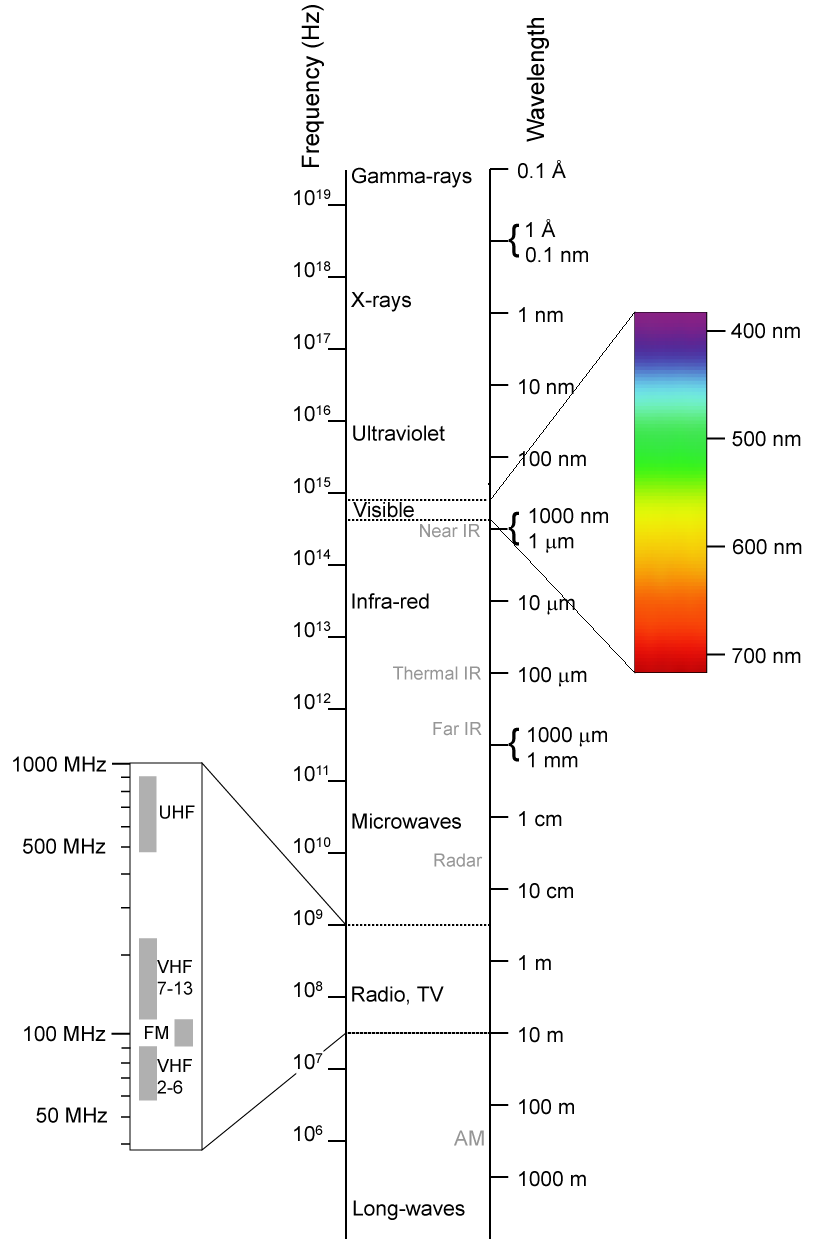
Next an attempt to quickly explain what radiation is: radiation is a very general term describing particles or waves traveling through a medium. Unfortunately some radiation is described as waves while other radiation is described as particles and sometimes people go back and forth. Explaining that takes some mind bending quantum mechanics, but we can skip over that. Most of the time when radiation is discussed it's either alpha/beta radiation which is typically viewed as particles. In general big doses of alpha/beta radiation come from radioactive elements and can be scary stuff. The other type is electromagnetic radiation which is typically described as a wave. All electromagnetic radiation is the same thing, just with different frequencies. It's a bit easier to think of it as a particle in which case frequency describes how much energy each particle has and power describes how many of those particles are flying around. The span of frequencies is essentially infinite, but the range people typically encounter is about 10^6 Hz (AM radio) to 10^19 Hz (gamma rays - hopefully you don't encounter these too often). This chart from wikipedia nicely shows the spectrum. Notice that 10^6 to 10^19 is a crazy huge range - gamma radiation's frequency is 10 trillion times greater than the frequency of AM radio.

So what makes some radiation scary and some radiation completely safe? Well to answer that we have to know what it can do to a person. Alpha/beta/gamma radiation can do some really nasty stuff that can kill fairly quickly as well as cause cancer - I don't know much about what it is doing when it kills quickly - probably just messing up a bunch of molecules by knocking out electrons. The main fear of radiation is that it causes cancer. It can also heat the inside of the body.

Well what about cancer? Radiation causes cancer by knocking electrons out of molecules in DNA. Once an electron is knocked out it can change the chemical properties and change what the DNA encodes. Then a bunch of biology can happen and end up causing cancer. In order to knock out an electron the radiation particle hitting the electron must have enough energy to knock it out. The key here is that the individual particle must have enough energy. No matter how many times someone lightly pokes you, you'll never break a bone. So if the particles are low energy/low frequency it doesn't matter what the power is. If the particles do have enough energy then the power, and exposure time, do matter because the more particles hitting you the more likely one will hit an electron and cause all the steps required to cause cancer. This is the difference between ionizing and non-ionizing radiation and is the key concept in knowing how dangerous radiation is.

So what radiation is ionizing? Ultraviolet light and higher frequencies, so around 10^16 Hz and above. Cellphones, portable phones, wifi, baby monitors, and bluetooth all use frequencies around 10^8 to 10^10 Hz, one millionth the frequency of ionizing radiation. Most other electronic communication standards use lower frequencies cause generating higher frequencies is really hard. Note that visible light is between any radiation generated by electronics and the frequency of ionizing energy.

Ok, so all these electronics devices don't use ionizing radiation, but microwaves don't use ionizing radiation (2.4*10^9 Hz) and everyone knows that if they stick their head in a microwave bad stuff happens. True, this gets us to the third issue with radiation which is that it can heat parts of your body. Microwaves are the prime example of this since they are designed specifically to heat water, 2.4 GHz is the resonate frequency of water. The human body works really hard to keep its innards within a very specific range of temperatures and outside of that stuff starts to breakdown and cause problems. WiFi uses the same frequency as microwaves and cell phones are sorta close. So it seems reasonable that they could cause heating which would then cause issues. Except they don't put out nearly enough power. Try reheating leftovers by putting your cell phone next to them. A common response is even if the power is small, people spend a lot of time with cell phones next to their heads. True, but again the human body works really hard to keep its insides at the right temperature, so it's not going to have any problem adjusting to some tiny bit of power. Consider that the human body can handle it being 100 degrees outside or 0 degrees outside and still stay 98.6 degrees. Compared to that getting rid of the tiny bit of heat from cell phone radiation is nothing - heck getting rid of the heat from the hot phone touching your head is probably the bigger issue. Microwaves generate about 700 watts of radiation, cell phones max out around 2 watts.

Yeah you say all that, but what about those big studies that show that cellphones cause bad stuff? For that I refer you to my post about shoulder tapping.

A few bonus items:
-People who live near cell phone towers are actually exposed to less cell phone radiation. Most of the exposure is from their phone, which doesn't need to transmit as much power if it is close to a tower.
-If you notice that your ear feels kinda warm and weird after a long phone call on a cell phone, it isn't cause of the radiation, it's cause you were holding a hot, hard object against your ear for a long time. Normal phones have a more comfortable shape and don't get as hot.

If you're still worried about cell phone radiation:
-When you're talking the phone has to transmit a bunch of data so it is almost constantly sending out radiation. When you aren't talking it's just checking in with the tower every once in a while so the amount of radiation exposure is far lower.
-Radiation falls off with distance squared so moving the phone just a little further from your head significantly cuts down on the radiation, plus your ear will appreciate not being pressed against a hot object.
-Bluetooth only needs to cover from your ear to your phone, vs a phone that has to talk to a tower. So bluetooth head sets do transmit significantly less radiation.
-WiFi is actually the one that is the right frequency to heat water. But its range (and transmit power) is much less than a cell phone and people generally don't hold their computer or access point to their head. Sleeping near an access point isn't a big deal because there typically isn't a lot of traffic on your wireless network while you're asleep.
-It might seem that something like streaming a movie would cause more radiation from your phone/laptop because more data is moving over the wireless connection. But when downloading data the only transmitting the device needs to do is send acknowledgements that it's getting the data. That's more transmitting than when the device is doing nothing, but far less than if you're sending a movie to someone.
-Frequency, power and duration are all key to understanding the impacts of radiation so watch carefully what terms are being used when reading about the topic.

Wednesday, December 15, 2010

Wikileaks

I probably shouldn't apologize every time I write a post that ends up too long, so this is me trying not to apologize even though I am sorry.

What I find so interesting about all the recent activity surrounding wikileaks is how it combines many of the social concepts associated with the internet.

One of the big memes when the intertubes first popped up and still one of the semi-utopian ideals of the internet is anonymity, summed up by the phrase on the internet nobody knows you're a dog. This sense of privacy has quickly eroded, but the internet is still a great way to get to interact with the world without anyone knowing who you are (if that no longer seems true, go check out TOR).

Another big meme which started long before the series of pipes and tubes was made, but was truly able to take off because of the internet is information wants to be free.

These two concepts are often promoted by the same people and organizations (such as The EFF, Richard Stallman, and to a much lesser degree myself). While it may be possible to mesh the two concepts into a consistent framework by drawing some lines, there's clearly some conflict between wanting transparency and privacy.

To me these have coexisted as two of the pillars of the social movement around the internet and the wikileaks events so nicely brings them out and especially their conflicts. Such as a secret organization, where one of the key enabling factors is their ability to give information sources complete anonymity, whose stated goal is increased transparency. Then a group that actually calls itself anonymous supports the group dedicated to transparency by disabling websites while ignoring the fact that shutting down websites is the opposite of promoting free speech.

This whole post so far is essentially a long drawn out version of this xkcd comic.

In addition to those two long standing concepts, a more recent idea comes into the picture. While net neutrality is typically discussed in relation to making sure ISPs treat everyone equally, the concept can also apply to webhosts refusing to host certain content. And even more disturbing, credit cards and paypal saying who you can and cannot pay using their services based on disapproving of what the organization says.

Another concept which I think is related to the idea that no one knows you're a dog is the idea that information should be put forward and evaluated on its own merits. I've mentioned this idea and its relationship to wikileaks before. This is one of the few concepts I'm mentioning that I am very wary of since I think that information without context can be misleading which is where experts can help clarify what the information actually means.

When the leaked documents first came out there was some commentary about it prompting security improvements. It is reasonably likely that wikileaks improved national security, because if they got the info then it seems reasonably likely that other nations and enemies of the state were already able to get it. But when wikileaks got the info the government found out so it is able to address the security weakness. There are a lot of existing computer security concepts related to this situation that I unfortunately don't know well enough to talk about (I know that usually doesn't stop me).

One thing I wonder is how the debate would change if instead of partially scrubbing the data, wikileaks was more like wikipedia and allowed the raw posted data to go up on the site. On one hand it seems much worse since potentially life threatening info could get out, but on the other hand it would make the poster responsible rather than the data hosting organization. Much like youtube isn't responsible if someone posts daily show episodes since they don't do anything to screen the posted content. Well ok, in the case of youtube they take down the offending material when contacted which of course wikileaks wouldn't do. Although by removing some of the data wikileaks is choosing what information to host and what information not to host much like what amazon did when they stopped hosting wikileaks. Holly crap, I'm now arguing that Assange isn't sufficiently dedicated to transparency, time to move along.

Anyway, kinda cool to see all those major concepts interacting over the course of a single news story, although it does make it really hard to come up with an opinion. But, I really think the reason this has become such a big story is that unlike the previous leak, no one knows who leaked the info. So everyone, including the government, is trying to place the blame somewhere. When the source of the leak is known it is so straight forward that the person who stole the info is guilty and having found the person to blame we can all just move along. But without that clear answer we get stuck in this area where all these normally great principals don't quite fit together.

Tuesday, December 14, 2010

David's Second Rule for Debugging

Way back when I came up with David's Rule for Debugging, then read a book about debugging with a more comprehensive set of rules. Since then I've added a new rule to my list. The exact rule is still a bit of a work in progress, and it has some similarity to "get a fresh view", but I think has some unique aspects. So here it goes.

In its most extreme form the rule is:
If you feel nauseous or about to cry, let other people help you.


I tried writing this post in a general way using third person but it was making it very tough to write so I'll just go with first person.

When I'm facing a problem, typically at first I'll want to think about it and look at it either on my own or as part of a small group. Later I might get around to "get a fresh perspective", but first I'll want a chance to get an understanding of the situation. This is especially true for high pressure/high excitement situations, which is unfortunate since that's when lots of people want to come by and get involved or give some advice. My general response is to try to gently push them away so I can get my chance to think/work (they typically don't leave, but I try).

However, there is a special case when the event is so high pressure and the results are so bad and make so little sense that the pressure gets to me and I start to feel nauseous. My gut reaction as the stress steps up is to push people away harder so I can dedicate my diminishing focus on the problem. But once nausea has kicked in there really isn't any focus or wits left to dedicate to the problem. That's when the rule kicks into effect, since I'm no longer of any use the best thing I can do is back away. Even if the people stopping by are normally less qualified to work on the problem, at this point random people off the street would have better luck solving it, so let them have at it. This also allows me to regain composure by stepping back rather than focusing in.

Luckily, I've only been in this situation once in recent memory and one of the people who stopped by was the exact right person to solve the problem. Unfortunately, I hadn't come up with this rule yet so I resisted help for longer than I should have, but eventually just had to back away. Also luckily, the person who solved the problem did it impressively quickly and once that was taken care of everything worked really well.

Can't say I'm looking forward to getting to use this rule, but at least if it happens I'll be prepared, well if I have enough wits left to use it - maybe the rule should be adjusted to: ...BEFORE you feel nauseous...

Thursday, December 09, 2010

To Engineer Is Human

I finished up To Engineer Is Human a few weeks ago, but have been considering how to blog about it in the back of my head. It is a book from 1982 that is supposed to be about engineering in generally, but is almost entirely focused on structural engineering (and at the very end has a short chapter about using computer aided design). While it does have some general engineering lessons, it really isn't very relevant to pretty much anyone I know reading this blog. So while I'm tempted to dig into a bunch of examples in the book I'm going to try to just skim some highlights.

First off is he mentions The Deacon's Masterpiece which is one of the few engineering poems I've ever read. The poem itself is rather long, but the idea is that someone decides that for any wagon there's always one thing that breaks first. So he's going to design each piece of the wagon so it won't be the first to go. And the thing works great for years and years and eventually every part fails at once and the whole thing falls apart. It's pointing out that in any design, no matter how good there has to always be a weak point.

One of the main themes of the book is that the reliability of structures kind of goes in cycles. Once a type of bridge has been design properly with a certain set of materials so it doesn't fall one of a few things happen:
1. The same design is used in a different set of conditions and fails. Then the engineers figure out what is required for that set of conditions.
2. Lessons of the past are forgotten and repeated. Once the new bridge fails the lessons are remembered and the next set of bridges are good again.
3. Since the current bridges are good it is time for progress and new designs or new materials or the same idea but with less safety margin are used. Then if there are failures the issues are worked out and then some better reliable bridges are built.

Along similar lines he suggests that every design is a hypothesis. The hypothesis is the design will work without failure. When the hypothesis fails it can be very unfortunate, but it is also the most informative. When the structure doesn't fail it doesn't say much because who knows what slight change in conditions would cause it to fail.

The two themes above suggest the problem with using structural engineering to draw general lessons for all engineering. In many areas of engineering failure is not as catastrophic and as long as failure rates are within acceptable limits meeting performance requirements can be far more important.

A lot of the book is going through various structural failures and talking about why they happened. One of particular interest to me is the Kansas City Hyatt Walkway Failure. Less than a month after I was born the Kansas City Hyatt was hosting a large party, which some of my family members almost attended, and the walkways over the lobby where the party was held collapsed and killed 114 people. Some of the initial thoughts were that the walkways simply weren't designed for people dancing on them. What actually happened is that the original design used beams that stretched from the ceiling and each beam supported multiple levels of walkways. But getting bolts to the middle of a long beam was practically very difficult so someone modified the design to have one beam from ceiling to the top level and then another beam from the top walkway to the bottom walkway. The problem is that now the bolt holding the top walk way had to support the weight of two levels instead of just one. Besides the personal relevance of the story I think this is interesting because it is tempting to blame whoever made the change at the last minute. But it is also the fault of the original designer for creating a design that couldn't actually be built or as someone else put it:
A detail that begs a change cannot be completely without blame when the change is made.


Few other random items:
-Kind of cool to see a book from 1982 mention a congressman working on improving safety regulations and it's Al Gore.
-Excalibur and other sword myths have a lot to do with engineering (why when a bunch of swords are built one is especially reliable). So is Icarus (wings melting as he tried to fly to the sun) - this one is really about a good design being used improperly (for the SGU fans - get it, the Icarus planet, get it? - oh and for the SG1/SGA fans, Daedalus is the guy that built the wings). And the liberty bell is an engineering failure.
-In this book written in 1982:
Computer models that predict the behavior of the economy have come increasingly to be relied upon to justify major economic decisions, and yet these models are not necessarily any more infallible than the ones that predict the fatigue life of a bus frame.

-This one is actually an important lesson in many aspects of life - random failures can be mitigated by having two of something, but to backup against systematic failure the backup must be of a different design (a friend has a story about a bunch of people backpacking who all brought water pumps so they'd be ok if a few broke, but then the temperature dropped and all of the pumps froze - luckily some of them had iodine tablets).

Oh crap, so much for not writing too much. Sorry.

Monday, November 29, 2010

Shoulder Tapping

Let's say that for some reason Justin Bieber picks up the habit of tapping people on the shoulder. Then, of course, in a few days every kid in America is tapping everyone they see on the shoulder. The next logical step is some parents get concerned about the health effects of shoulder tapping and make sure that scientists studying shoulder tapping get funded.

Let's say that 200 studies are started. Each study picks a different health effect that seems like it could be connected (impact on bone structure, passing of germs, social anxiety...) and checks if it is correlated with shoulder tapping. These are real scientists who know what they are doing so they properly account for external factors and other correlations and thanks to all the funding are able to get such a large sample size that each study has a confidence level of 99%.

Then a journalist or study of studies scientist comes along and asks every scientist what they found. Turns out that with 99% confidence shoulder tapping causes peripheral vision loss.

There's no theory why shoulder tapping causes peripheral vision loss, but if there's a study showing a chance it is true then best to try to kill the new trend right?

Well, actually, even if there is no correlation between shoulder tapping and any of the studied health effects, the odds that 1 or more studies out of 200 would show a correlation with 99% confidence is 87%. (1-0.99^200). It is actually rather likely that there would be a false positive (even with only 69 studies there's a 50% chance of false positive, and with only 10 studies there's a 10% chance of false positive, much smaller, but still 10x worse than the quoted 99% confidence level).

While the individual studies were done with proper statistics the news story/study of studies was actually done with very poor statistics. Now if a scientist read the news article and then repeated the study of peripheral vision loss and again found a correlation with 99% confidence that would be worth reporting. Of course there would still be some question as to causation, but at least it would be true that there is very likely a correlation.

Sunday, November 14, 2010

Wheel of Time 4-7

I figured there's no point in putting up a post for each Wheel of Time book. But I just hit the half way point by finishing book 7. Since I'm in the weird position of being 5,926 pages into the series and thus would have to write a whole book just to summarize and yet only half way in so not even sure where the whole thing is going I won't say much other than good stuff so far.

Actually I take back the summary thing - several young adults plucked out of a small town are exposed to the larger world and meet a variety of other people while on their mission to fight evil using their newly found magic and special powers. I could totally be an author, all Robert Jordan did was fill in some details.