Apparently we still haven't reached the day when I'll stop posting about the status of patents I'm on.
My second patent (which I'm also first inventor on) was just granted! And the version with pretty pictures. (8/16/2011 link fixed)
Showing posts with label EE. Show all posts
Showing posts with label EE. Show all posts
Friday, August 12, 2011


Tuesday, June 14, 2011
Patent Granted!
For those who missed it on the twitter feed, I'm first inventor on a patent that was just granted!
For those who did see it on the twitter feed this link includes the pretty pictures along with the text:
MULTIPLE BATTERY CONFIGURATIONS IN AN IMPLANTABLE MEDICAL DEVICE.
Actually the link above is the application, here's the link to the granted patent.
For those who did see it on the twitter feed this link includes the pretty pictures along with the text:
MULTIPLE BATTERY CONFIGURATIONS IN AN IMPLANTABLE MEDICAL DEVICE.
Actually the link above is the application, here's the link to the granted patent.
Saturday, January 29, 2011
Why School Science Experiments Should Be Replaced By Engineering
Disclaimer: This post is a bunch of stuff I just thought up and is mostly about education. I did ok as a student, but know almost nothing about teaching. So the bullshit meter on this post is higher than usual. And I'm really just writing this as a way to put off doing taxes (as a side note, if Republicans wanted to destroy Democrats they'd move elections to mid April).
The build up to this post is the general concept of evaluating information, especially who to trust (school, scientists, religious leaders, parents, no one decide for self...). I'm going to try to skip past my giant set of rants on this topic, especially since I've touched on it in several posts. But the starting off point is that most of these sources often end up saying just trust me and then can't believe when people put their trust in an alternate source (school and science that includes you).
While school is not a perfect source of information, it is generally better than any of the others and is at least a good starting point. So I'd say that two things schools should aim for are showing why school should mostly (but not absolutely) be trusted and more generally teaching how to evaluate sources of information.
I think that science education is a logical starting point for teaching how to evaluate sources of information and demonstrating the validity of information from school. Especially since it is generally the only subject that has demonstrations of any kind (name another subject in which what is being taught is actually tested in any way, except maybe self consistency in mathematics but that's rather abstract). This means that science experiments are far more important as a piece of education as a whole than they might appear at first.
Problem is, I'd claim, that school science experiments are flawed. Let's say students are doing the time an object falling experiment. The hypothesis is something like "gravity accelerates objects near Earth's surface at approximately 9.81m/s^2" right? Wrong! Everyone knows that's correct and if the experiment proves it wrong the student doesn't get to publish an article in Nature, she/he gets to repeat the experiment again till the "hypothesis" is proved true. That's about as far from science as you can get. The real hypothesis is something along the lines of "what teachers tell me is generally correct and provides information about how the world works", and increasingly has the add on of "science/school is fun".
Well, if that's the hypothesis then doing the object drop experiment is still bad science. Why? Well, let's take another example. Someone on the street says the way to add two numbers is to just add 5 to the first number. Now to prove it try doing 6+5, ok how about 7+5. See the rule works, now trust me. The natural reaction should be, let me come up with a set of numbers to add to test this rule and it would quickly be proven false.
So doing a proscribed experiment doesn't go very far in answering the true hypothesis. The students need to design their own experiments. But the answer to any experiment most students would do is already well known and they'd still be expected to get the correct answer. It is a step in the right direction, but I'd claim that far better would be to ask a student to design something using the knowledge they've been given. When a student is able to use their knowledge to create something that works that is a powerful moment. It shows the knowledge they have works even when tested in the way the student chooses. It means that the student isn't just repeating whatever they do till they get a right answer. And I'd claim it is more fun (although that may just be my opinion).
Now there is a huge issue with building something. It very often won't work. If the project stops there then science is disproved, school is bullshit and it is time to start reading websites about how the moon landing was faked. However, if the student has to figure out why it didn't work and then redesign based on that info then the student is testing whatever science comes up rather than whatever was being taught that week. This becomes a much better test of the reliability of information taught in school. Additionally, many people don't consider science sufficiently "magical", and I think that finding unexpected issues and their causes can help demonstrate how mysterious and "magical" science can be.
Not to mention that if the design is sufficiently interesting the hypothesis can be adjusted to "what teachers tell me is generally correct and provides USEFUL information about how the world works".
In addition to increasing trust in school, now the student knows that some sources provide information that can be used in interactions with the world. Which means that other information sources can be tested for the same ability. Thus, giving the student a tool for evaluating sources of information in general.
Alright, I'll admit the argument doesn't hold together perfectly (not to mention being built on complete ignorance about teaching), but there it is. I guess I should also admit that it isn't surprising that I think the key to making people smarter (aka thinking more like me) is to get them to do more of what I do.
Thursday, December 16, 2010
Oh no, Radiation, Ahhhhhh!
I tried so hard to make this post short and simple and failed so badly, if you want you can just head to this wikipedia article on ionizing radiation or the epa's page on the topic and get a more coherent version of this post. Otherwise you can continue reading why the person who makes his money designing circuits that put radiation in the air thinks that radiation from electronics is safe.
Unfortunately very few people really know physics and very few people really know biology and especially since they are on somewhat opposite ends of the science spectrum an extremely small number of people really know both. This leads to a lot of confusion over how radiation impacts people.
I definitely can't claim to really know biology, but I do know some physics especially when it comes to a certain range of the electromagnetic spectrum. So I'm going to try to spread a bit of knowledge about the subject.
First of all, radiation sounds scary right? Well some of it is. If someone says there's a big source of alpha radiation near by then run. But when I tell you that in order to read this post you have to bombard your eyes with radiation and that each particle of that radiation is far more energetic than those created in a microwave, you should stay calm cause I'm talking about visible light.
Next an attempt to quickly explain what radiation is: radiation is a very general term describing particles or waves traveling through a medium. Unfortunately some radiation is described as waves while other radiation is described as particles and sometimes people go back and forth. Explaining that takes some mind bending quantum mechanics, but we can skip over that. Most of the time when radiation is discussed it's either alpha/beta radiation which is typically viewed as particles. In general big doses of alpha/beta radiation come from radioactive elements and can be scary stuff. The other type is electromagnetic radiation which is typically described as a wave. All electromagnetic radiation is the same thing, just with different frequencies. It's a bit easier to think of it as a particle in which case frequency describes how much energy each particle has and power describes how many of those particles are flying around. The span of frequencies is essentially infinite, but the range people typically encounter is about 10^6 Hz (AM radio) to 10^19 Hz (gamma rays - hopefully you don't encounter these too often). This chart from wikipedia nicely shows the spectrum. Notice that 10^6 to 10^19 is a crazy huge range - gamma radiation's frequency is 10 trillion times greater than the frequency of AM radio.
So what makes some radiation scary and some radiation completely safe? Well to answer that we have to know what it can do to a person. Alpha/beta/gamma radiation can do some really nasty stuff that can kill fairly quickly as well as cause cancer - I don't know much about what it is doing when it kills quickly - probably just messing up a bunch of molecules by knocking out electrons. The main fear of radiation is that it causes cancer. It can also heat the inside of the body.
Well what about cancer? Radiation causes cancer by knocking electrons out of molecules in DNA. Once an electron is knocked out it can change the chemical properties and change what the DNA encodes. Then a bunch of biology can happen and end up causing cancer. In order to knock out an electron the radiation particle hitting the electron must have enough energy to knock it out. The key here is that the individual particle must have enough energy. No matter how many times someone lightly pokes you, you'll never break a bone. So if the particles are low energy/low frequency it doesn't matter what the power is. If the particles do have enough energy then the power, and exposure time, do matter because the more particles hitting you the more likely one will hit an electron and cause all the steps required to cause cancer. This is the difference between ionizing and non-ionizing radiation and is the key concept in knowing how dangerous radiation is.
So what radiation is ionizing? Ultraviolet light and higher frequencies, so around 10^16 Hz and above. Cellphones, portable phones, wifi, baby monitors, and bluetooth all use frequencies around 10^8 to 10^10 Hz, one millionth the frequency of ionizing radiation. Most other electronic communication standards use lower frequencies cause generating higher frequencies is really hard. Note that visible light is between any radiation generated by electronics and the frequency of ionizing energy.
Ok, so all these electronics devices don't use ionizing radiation, but microwaves don't use ionizing radiation (2.4*10^9 Hz) and everyone knows that if they stick their head in a microwave bad stuff happens. True, this gets us to the third issue with radiation which is that it can heat parts of your body. Microwaves are the prime example of this since they are designed specifically to heat water, 2.4 GHz is the resonate frequency of water. The human body works really hard to keep its innards within a very specific range of temperatures and outside of that stuff starts to breakdown and cause problems. WiFi uses the same frequency as microwaves and cell phones are sorta close. So it seems reasonable that they could cause heating which would then cause issues. Except they don't put out nearly enough power. Try reheating leftovers by putting your cell phone next to them. A common response is even if the power is small, people spend a lot of time with cell phones next to their heads. True, but again the human body works really hard to keep its insides at the right temperature, so it's not going to have any problem adjusting to some tiny bit of power. Consider that the human body can handle it being 100 degrees outside or 0 degrees outside and still stay 98.6 degrees. Compared to that getting rid of the tiny bit of heat from cell phone radiation is nothing - heck getting rid of the heat from the hot phone touching your head is probably the bigger issue. Microwaves generate about 700 watts of radiation, cell phones max out around 2 watts.
Yeah you say all that, but what about those big studies that show that cellphones cause bad stuff? For that I refer you to my post about shoulder tapping.
A few bonus items:
-People who live near cell phone towers are actually exposed to less cell phone radiation. Most of the exposure is from their phone, which doesn't need to transmit as much power if it is close to a tower.
-If you notice that your ear feels kinda warm and weird after a long phone call on a cell phone, it isn't cause of the radiation, it's cause you were holding a hot, hard object against your ear for a long time. Normal phones have a more comfortable shape and don't get as hot.
If you're still worried about cell phone radiation:
-When you're talking the phone has to transmit a bunch of data so it is almost constantly sending out radiation. When you aren't talking it's just checking in with the tower every once in a while so the amount of radiation exposure is far lower.
-Radiation falls off with distance squared so moving the phone just a little further from your head significantly cuts down on the radiation, plus your ear will appreciate not being pressed against a hot object.
-Bluetooth only needs to cover from your ear to your phone, vs a phone that has to talk to a tower. So bluetooth head sets do transmit significantly less radiation.
-WiFi is actually the one that is the right frequency to heat water. But its range (and transmit power) is much less than a cell phone and people generally don't hold their computer or access point to their head. Sleeping near an access point isn't a big deal because there typically isn't a lot of traffic on your wireless network while you're asleep.
-It might seem that something like streaming a movie would cause more radiation from your phone/laptop because more data is moving over the wireless connection. But when downloading data the only transmitting the device needs to do is send acknowledgements that it's getting the data. That's more transmitting than when the device is doing nothing, but far less than if you're sending a movie to someone.
-Frequency, power and duration are all key to understanding the impacts of radiation so watch carefully what terms are being used when reading about the topic.
Unfortunately very few people really know physics and very few people really know biology and especially since they are on somewhat opposite ends of the science spectrum an extremely small number of people really know both. This leads to a lot of confusion over how radiation impacts people.
I definitely can't claim to really know biology, but I do know some physics especially when it comes to a certain range of the electromagnetic spectrum. So I'm going to try to spread a bit of knowledge about the subject.
First of all, radiation sounds scary right? Well some of it is. If someone says there's a big source of alpha radiation near by then run. But when I tell you that in order to read this post you have to bombard your eyes with radiation and that each particle of that radiation is far more energetic than those created in a microwave, you should stay calm cause I'm talking about visible light.
Next an attempt to quickly explain what radiation is: radiation is a very general term describing particles or waves traveling through a medium. Unfortunately some radiation is described as waves while other radiation is described as particles and sometimes people go back and forth. Explaining that takes some mind bending quantum mechanics, but we can skip over that. Most of the time when radiation is discussed it's either alpha/beta radiation which is typically viewed as particles. In general big doses of alpha/beta radiation come from radioactive elements and can be scary stuff. The other type is electromagnetic radiation which is typically described as a wave. All electromagnetic radiation is the same thing, just with different frequencies. It's a bit easier to think of it as a particle in which case frequency describes how much energy each particle has and power describes how many of those particles are flying around. The span of frequencies is essentially infinite, but the range people typically encounter is about 10^6 Hz (AM radio) to 10^19 Hz (gamma rays - hopefully you don't encounter these too often). This chart from wikipedia nicely shows the spectrum. Notice that 10^6 to 10^19 is a crazy huge range - gamma radiation's frequency is 10 trillion times greater than the frequency of AM radio.
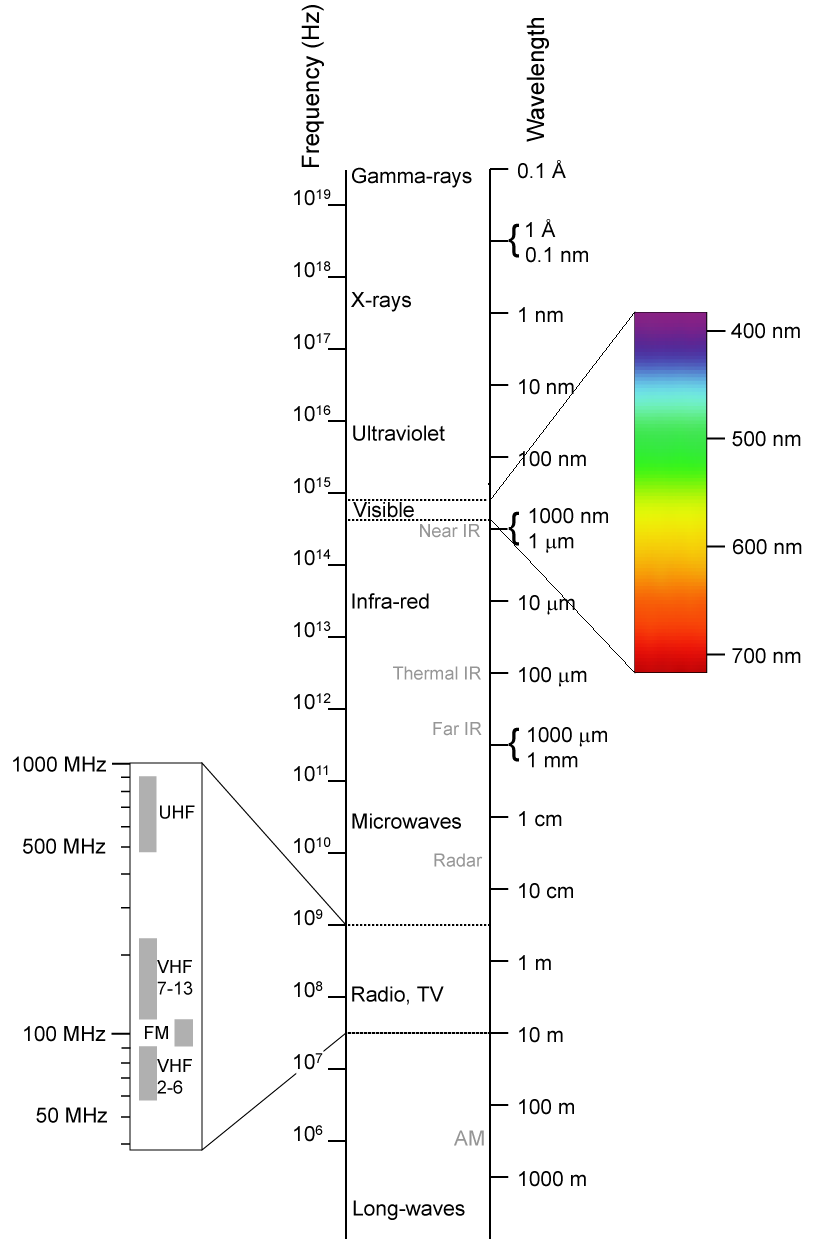
So what makes some radiation scary and some radiation completely safe? Well to answer that we have to know what it can do to a person. Alpha/beta/gamma radiation can do some really nasty stuff that can kill fairly quickly as well as cause cancer - I don't know much about what it is doing when it kills quickly - probably just messing up a bunch of molecules by knocking out electrons. The main fear of radiation is that it causes cancer. It can also heat the inside of the body.
Well what about cancer? Radiation causes cancer by knocking electrons out of molecules in DNA. Once an electron is knocked out it can change the chemical properties and change what the DNA encodes. Then a bunch of biology can happen and end up causing cancer. In order to knock out an electron the radiation particle hitting the electron must have enough energy to knock it out. The key here is that the individual particle must have enough energy. No matter how many times someone lightly pokes you, you'll never break a bone. So if the particles are low energy/low frequency it doesn't matter what the power is. If the particles do have enough energy then the power, and exposure time, do matter because the more particles hitting you the more likely one will hit an electron and cause all the steps required to cause cancer. This is the difference between ionizing and non-ionizing radiation and is the key concept in knowing how dangerous radiation is.
So what radiation is ionizing? Ultraviolet light and higher frequencies, so around 10^16 Hz and above. Cellphones, portable phones, wifi, baby monitors, and bluetooth all use frequencies around 10^8 to 10^10 Hz, one millionth the frequency of ionizing radiation. Most other electronic communication standards use lower frequencies cause generating higher frequencies is really hard. Note that visible light is between any radiation generated by electronics and the frequency of ionizing energy.
Ok, so all these electronics devices don't use ionizing radiation, but microwaves don't use ionizing radiation (2.4*10^9 Hz) and everyone knows that if they stick their head in a microwave bad stuff happens. True, this gets us to the third issue with radiation which is that it can heat parts of your body. Microwaves are the prime example of this since they are designed specifically to heat water, 2.4 GHz is the resonate frequency of water. The human body works really hard to keep its innards within a very specific range of temperatures and outside of that stuff starts to breakdown and cause problems. WiFi uses the same frequency as microwaves and cell phones are sorta close. So it seems reasonable that they could cause heating which would then cause issues. Except they don't put out nearly enough power. Try reheating leftovers by putting your cell phone next to them. A common response is even if the power is small, people spend a lot of time with cell phones next to their heads. True, but again the human body works really hard to keep its insides at the right temperature, so it's not going to have any problem adjusting to some tiny bit of power. Consider that the human body can handle it being 100 degrees outside or 0 degrees outside and still stay 98.6 degrees. Compared to that getting rid of the tiny bit of heat from cell phone radiation is nothing - heck getting rid of the heat from the hot phone touching your head is probably the bigger issue. Microwaves generate about 700 watts of radiation, cell phones max out around 2 watts.
Yeah you say all that, but what about those big studies that show that cellphones cause bad stuff? For that I refer you to my post about shoulder tapping.
A few bonus items:
-People who live near cell phone towers are actually exposed to less cell phone radiation. Most of the exposure is from their phone, which doesn't need to transmit as much power if it is close to a tower.
-If you notice that your ear feels kinda warm and weird after a long phone call on a cell phone, it isn't cause of the radiation, it's cause you were holding a hot, hard object against your ear for a long time. Normal phones have a more comfortable shape and don't get as hot.
If you're still worried about cell phone radiation:
-When you're talking the phone has to transmit a bunch of data so it is almost constantly sending out radiation. When you aren't talking it's just checking in with the tower every once in a while so the amount of radiation exposure is far lower.
-Radiation falls off with distance squared so moving the phone just a little further from your head significantly cuts down on the radiation, plus your ear will appreciate not being pressed against a hot object.
-Bluetooth only needs to cover from your ear to your phone, vs a phone that has to talk to a tower. So bluetooth head sets do transmit significantly less radiation.
-WiFi is actually the one that is the right frequency to heat water. But its range (and transmit power) is much less than a cell phone and people generally don't hold their computer or access point to their head. Sleeping near an access point isn't a big deal because there typically isn't a lot of traffic on your wireless network while you're asleep.
-It might seem that something like streaming a movie would cause more radiation from your phone/laptop because more data is moving over the wireless connection. But when downloading data the only transmitting the device needs to do is send acknowledgements that it's getting the data. That's more transmitting than when the device is doing nothing, but far less than if you're sending a movie to someone.
-Frequency, power and duration are all key to understanding the impacts of radiation so watch carefully what terms are being used when reading about the topic.
Tuesday, December 14, 2010
David's Second Rule for Debugging
Way back when I came up with David's Rule for Debugging, then read a book about debugging with a more comprehensive set of rules. Since then I've added a new rule to my list. The exact rule is still a bit of a work in progress, and it has some similarity to "get a fresh view", but I think has some unique aspects. So here it goes.
In its most extreme form the rule is:
I tried writing this post in a general way using third person but it was making it very tough to write so I'll just go with first person.
When I'm facing a problem, typically at first I'll want to think about it and look at it either on my own or as part of a small group. Later I might get around to "get a fresh perspective", but first I'll want a chance to get an understanding of the situation. This is especially true for high pressure/high excitement situations, which is unfortunate since that's when lots of people want to come by and get involved or give some advice. My general response is to try to gently push them away so I can get my chance to think/work (they typically don't leave, but I try).
However, there is a special case when the event is so high pressure and the results are so bad and make so little sense that the pressure gets to me and I start to feel nauseous. My gut reaction as the stress steps up is to push people away harder so I can dedicate my diminishing focus on the problem. But once nausea has kicked in there really isn't any focus or wits left to dedicate to the problem. That's when the rule kicks into effect, since I'm no longer of any use the best thing I can do is back away. Even if the people stopping by are normally less qualified to work on the problem, at this point random people off the street would have better luck solving it, so let them have at it. This also allows me to regain composure by stepping back rather than focusing in.
Luckily, I've only been in this situation once in recent memory and one of the people who stopped by was the exact right person to solve the problem. Unfortunately, I hadn't come up with this rule yet so I resisted help for longer than I should have, but eventually just had to back away. Also luckily, the person who solved the problem did it impressively quickly and once that was taken care of everything worked really well.
Can't say I'm looking forward to getting to use this rule, but at least if it happens I'll be prepared, well if I have enough wits left to use it - maybe the rule should be adjusted to: ...BEFORE you feel nauseous...
In its most extreme form the rule is:
If you feel nauseous or about to cry, let other people help you.
I tried writing this post in a general way using third person but it was making it very tough to write so I'll just go with first person.
When I'm facing a problem, typically at first I'll want to think about it and look at it either on my own or as part of a small group. Later I might get around to "get a fresh perspective", but first I'll want a chance to get an understanding of the situation. This is especially true for high pressure/high excitement situations, which is unfortunate since that's when lots of people want to come by and get involved or give some advice. My general response is to try to gently push them away so I can get my chance to think/work (they typically don't leave, but I try).
However, there is a special case when the event is so high pressure and the results are so bad and make so little sense that the pressure gets to me and I start to feel nauseous. My gut reaction as the stress steps up is to push people away harder so I can dedicate my diminishing focus on the problem. But once nausea has kicked in there really isn't any focus or wits left to dedicate to the problem. That's when the rule kicks into effect, since I'm no longer of any use the best thing I can do is back away. Even if the people stopping by are normally less qualified to work on the problem, at this point random people off the street would have better luck solving it, so let them have at it. This also allows me to regain composure by stepping back rather than focusing in.
Luckily, I've only been in this situation once in recent memory and one of the people who stopped by was the exact right person to solve the problem. Unfortunately, I hadn't come up with this rule yet so I resisted help for longer than I should have, but eventually just had to back away. Also luckily, the person who solved the problem did it impressively quickly and once that was taken care of everything worked really well.
Can't say I'm looking forward to getting to use this rule, but at least if it happens I'll be prepared, well if I have enough wits left to use it - maybe the rule should be adjusted to: ...BEFORE you feel nauseous...
Thursday, December 09, 2010
To Engineer Is Human
I finished up To Engineer Is Human a few weeks ago, but have been considering how to blog about it in the back of my head. It is a book from 1982 that is supposed to be about engineering in generally, but is almost entirely focused on structural engineering (and at the very end has a short chapter about using computer aided design). While it does have some general engineering lessons, it really isn't very relevant to pretty much anyone I know reading this blog. So while I'm tempted to dig into a bunch of examples in the book I'm going to try to just skim some highlights.
First off is he mentions The Deacon's Masterpiece which is one of the few engineering poems I've ever read. The poem itself is rather long, but the idea is that someone decides that for any wagon there's always one thing that breaks first. So he's going to design each piece of the wagon so it won't be the first to go. And the thing works great for years and years and eventually every part fails at once and the whole thing falls apart. It's pointing out that in any design, no matter how good there has to always be a weak point.
One of the main themes of the book is that the reliability of structures kind of goes in cycles. Once a type of bridge has been design properly with a certain set of materials so it doesn't fall one of a few things happen:
1. The same design is used in a different set of conditions and fails. Then the engineers figure out what is required for that set of conditions.
2. Lessons of the past are forgotten and repeated. Once the new bridge fails the lessons are remembered and the next set of bridges are good again.
3. Since the current bridges are good it is time for progress and new designs or new materials or the same idea but with less safety margin are used. Then if there are failures the issues are worked out and then some better reliable bridges are built.
Along similar lines he suggests that every design is a hypothesis. The hypothesis is the design will work without failure. When the hypothesis fails it can be very unfortunate, but it is also the most informative. When the structure doesn't fail it doesn't say much because who knows what slight change in conditions would cause it to fail.
The two themes above suggest the problem with using structural engineering to draw general lessons for all engineering. In many areas of engineering failure is not as catastrophic and as long as failure rates are within acceptable limits meeting performance requirements can be far more important.
A lot of the book is going through various structural failures and talking about why they happened. One of particular interest to me is the Kansas City Hyatt Walkway Failure. Less than a month after I was born the Kansas City Hyatt was hosting a large party, which some of my family members almost attended, and the walkways over the lobby where the party was held collapsed and killed 114 people. Some of the initial thoughts were that the walkways simply weren't designed for people dancing on them. What actually happened is that the original design used beams that stretched from the ceiling and each beam supported multiple levels of walkways. But getting bolts to the middle of a long beam was practically very difficult so someone modified the design to have one beam from ceiling to the top level and then another beam from the top walkway to the bottom walkway. The problem is that now the bolt holding the top walk way had to support the weight of two levels instead of just one. Besides the personal relevance of the story I think this is interesting because it is tempting to blame whoever made the change at the last minute. But it is also the fault of the original designer for creating a design that couldn't actually be built or as someone else put it:
Few other random items:
-Kind of cool to see a book from 1982 mention a congressman working on improving safety regulations and it's Al Gore.
-Excalibur and other sword myths have a lot to do with engineering (why when a bunch of swords are built one is especially reliable). So is Icarus (wings melting as he tried to fly to the sun) - this one is really about a good design being used improperly (for the SGU fans - get it, the Icarus planet, get it? - oh and for the SG1/SGA fans, Daedalus is the guy that built the wings). And the liberty bell is an engineering failure.
-In this book written in 1982:
-This one is actually an important lesson in many aspects of life - random failures can be mitigated by having two of something, but to backup against systematic failure the backup must be of a different design (a friend has a story about a bunch of people backpacking who all brought water pumps so they'd be ok if a few broke, but then the temperature dropped and all of the pumps froze - luckily some of them had iodine tablets).
Oh crap, so much for not writing too much. Sorry.
First off is he mentions The Deacon's Masterpiece which is one of the few engineering poems I've ever read. The poem itself is rather long, but the idea is that someone decides that for any wagon there's always one thing that breaks first. So he's going to design each piece of the wagon so it won't be the first to go. And the thing works great for years and years and eventually every part fails at once and the whole thing falls apart. It's pointing out that in any design, no matter how good there has to always be a weak point.
One of the main themes of the book is that the reliability of structures kind of goes in cycles. Once a type of bridge has been design properly with a certain set of materials so it doesn't fall one of a few things happen:
1. The same design is used in a different set of conditions and fails. Then the engineers figure out what is required for that set of conditions.
2. Lessons of the past are forgotten and repeated. Once the new bridge fails the lessons are remembered and the next set of bridges are good again.
3. Since the current bridges are good it is time for progress and new designs or new materials or the same idea but with less safety margin are used. Then if there are failures the issues are worked out and then some better reliable bridges are built.
Along similar lines he suggests that every design is a hypothesis. The hypothesis is the design will work without failure. When the hypothesis fails it can be very unfortunate, but it is also the most informative. When the structure doesn't fail it doesn't say much because who knows what slight change in conditions would cause it to fail.
The two themes above suggest the problem with using structural engineering to draw general lessons for all engineering. In many areas of engineering failure is not as catastrophic and as long as failure rates are within acceptable limits meeting performance requirements can be far more important.
A lot of the book is going through various structural failures and talking about why they happened. One of particular interest to me is the Kansas City Hyatt Walkway Failure. Less than a month after I was born the Kansas City Hyatt was hosting a large party, which some of my family members almost attended, and the walkways over the lobby where the party was held collapsed and killed 114 people. Some of the initial thoughts were that the walkways simply weren't designed for people dancing on them. What actually happened is that the original design used beams that stretched from the ceiling and each beam supported multiple levels of walkways. But getting bolts to the middle of a long beam was practically very difficult so someone modified the design to have one beam from ceiling to the top level and then another beam from the top walkway to the bottom walkway. The problem is that now the bolt holding the top walk way had to support the weight of two levels instead of just one. Besides the personal relevance of the story I think this is interesting because it is tempting to blame whoever made the change at the last minute. But it is also the fault of the original designer for creating a design that couldn't actually be built or as someone else put it:
A detail that begs a change cannot be completely without blame when the change is made.
Few other random items:
-Kind of cool to see a book from 1982 mention a congressman working on improving safety regulations and it's Al Gore.
-Excalibur and other sword myths have a lot to do with engineering (why when a bunch of swords are built one is especially reliable). So is Icarus (wings melting as he tried to fly to the sun) - this one is really about a good design being used improperly (for the SGU fans - get it, the Icarus planet, get it? - oh and for the SG1/SGA fans, Daedalus is the guy that built the wings). And the liberty bell is an engineering failure.
-In this book written in 1982:
Computer models that predict the behavior of the economy have come increasingly to be relied upon to justify major economic decisions, and yet these models are not necessarily any more infallible than the ones that predict the fatigue life of a bus frame.
-This one is actually an important lesson in many aspects of life - random failures can be mitigated by having two of something, but to backup against systematic failure the backup must be of a different design (a friend has a story about a bunch of people backpacking who all brought water pumps so they'd be ok if a few broke, but then the temperature dropped and all of the pumps froze - luckily some of them had iodine tablets).
Oh crap, so much for not writing too much. Sorry.
Saturday, September 25, 2010
Shop Class As Soulcraft
Today I finished Shop Class As Soulcraft: An Inquiry Into The Value Of Work by Matthew B. Crawford.
The book makes the argument that separating knowledge from being able to work with the physical world is bad for workers in many ways. It is push back on the knowledge economy. The story is based on his own experience working as a motorcycle repairman after getting his PhD and working some office jobs.
If the subject makes you think of Zen And The Art Of Motorcycle Maintenance, there are a few shared ideas, but this book isn't insane.
I have mix feelings about this book.
First some good:
Sections of the book are clear articulations of thoughts that have guided my career and education. If anyone wants to understand why I chose electrical engineering over computer science and engineering over other fields, this book would be a good place to start - the core idea being working within the constraints of the physical world and seeing ones efforts cause something to actually work both theoretically and practically. Even though he does makes some comments about repair being superior to design (I think most of those comments are based on ignoring several aspects of design).
He even made some comments on creativity that very nearly matched my own.
Some ok:
He makes some good points about the modern office. Especially about how when people work in teams on poorly defined tasks it is difficult to evaluate the success of both the group and individual, vs in repair where either the repairman gets the motorcycle to work or doesn't. And how this puts managers in a strange position. Also how the knowledge of success vs failure is key to satisfaction in work. He also gets into how demoralizing it can be when the goal is something monetarily based, such as number of pages written, instead of working towards quality.
He also discusses how advertising and marketing reveals people's desires to build and repair their own stuff. He discusses marketing campaigns such as the Scion where they have people purchase options to make them feel like they are working on their car, when they are really just buying more stuff.
Some bad:
He takes most of his points to extremes - such as I toned the comments about the office way down.
My biggest issue with the book is that he encourages people to consider vocational school over college, especially since for some people they can make more money if they are willing to accept blue collar jobs. First, I question if that's true, much of the recent discussion of the labor market I've seen is about how recently those with college degrees are pulling even further ahead of those without. Second, even if it was, there are other reasons to go to college, such as just being an education person. Also this is one of the most "academic" books (outside of science and textbooks) that I've ever read which seems somewhat ironic given its subject matter. It's also a bit odd that a book suggesting going to votech made me feel like I should have taken a philosophy class before reading it.
The author doesn't bother at all with balance. He's all about getting away from specialization of labor as well as other aspects of corporations, but doesn't address what would happen if there was actually a major shift back to engineers doing their own building and writing their own user manuals. It never comes up that products would be significantly more expensive and the economy would tank. Not to mention that he does not suggest how reasonably complex projects would be designed or built. A good example of the lack of balance is when I made comments about creativity on this blog several people made good counterpoints and that's my personal blog - this book did nothing to address that there is more than one side to it.
Finally the size:
I really like the size of the book - it isn't a little pocket book, but still fits in a pocket so as I read through the wheel of time at home, I've been reading this book while doing laundry and hanging out on castro st. All books should be this size and if they need to be longer they can be split into multiple volumes. Also makes me wish there was a mini-kindle that bends a little.
Tuesday, August 31, 2010
Creativity
I'm going to talk about myself for a bit, since that's what I get to observe, but I'm trying to get to a broader point not just spout off about myself.
I feel like there's a "traditional" image of the path to creativity. A bunch of somewhat wacky looking people tossing a ball around while brainstorming in an office shaped like a castle or sitting in a hot springs on some company retreat (ok, maybe that's several images all jammed together). And part of the image is that those people are part of some cross disciplinary team or each has some broad range of work and life experiences. Think of the creativity posters with pictures of an old Einstein with crazy hair.
I've filled several invention disclosures at work. Some of which are working through the process to become patents. I'll admit that while each to the best of my knowledge is an original and useful idea, none of them is going to transform an industry or anything close to that. But I like to think that to have an original useful idea in a field that has been around a while and has a decent amount of competition takes some creativity.
I was thinking about what lead up to each of these inventions. Since I've never been to a meeting where a ball was tossed around and definitely never been to a company retreat with hot springs none of those were involved in the process. In fact the common theme in each case is either independently or in collaboration with one or two other coworkers I was digging deeply into the details of some aspect of a circuit I was working on. And in each case as I reached a certain level of discovery and understanding the new idea just flowed. And it was a single clear idea, not a giant list of brainstormed ideas. Each of these situations seemed almost the exact opposite of the "traditional" image of creativity.
Going back to Einstein for a moment. The old man with crazy hair really didn't do much. It was when he was a clean cut, suit wearing, patent clerk that he came up with mind blowing advances in physics. I will admit that I don't know a ton about Einstein, but my understanding is that most of his advancements came from thought experiments on his own, not brainstorming or even collaboration.
For my own example I wonder if while I'm being creative, maybe I'm not hitting a higher level of creativity that the "traditional" example would help me achieve. The higher level could be just how new the idea is, or could be the difference between creativity on the level of circuit details vs large system changes. However, that doesn't hold together when the Einstein example is considered.
I guess the answer is probably just that creativity is a large, poorly defined concept so different types of creativity require different approaches. And different people get to creativity by different means. In addition, crazy looking Einstein makes a better poster and a multidisciplinary teams going rafting makes a better story than an engineer focusing on a computer screen late at night. So those are the images of creativity that are spread.
Was that obvious? Is there something I missed? Am I over valuing engineering creativity - is a pixar writer so much more creative than a chip designer that the comparison doesn't even make sense? Does a pixar writer actually follow the "traditional" path or is that just a false image? Is "traditional" path really more about how to get a team to collaborate than how to maximize individual creativity?
Most of my random ramblings are just that. But in this case I'm actually reevaluating which assignments at work I want based on this idea. The "traditional" image of creativity that I have says bounce from area to area picking up broad knowledge to allow cross-pollination of ideas. But now I'm thinking that while breadth shouldn't be ignored, my own path to creativity is to go further in depth.
Saturday, August 07, 2010
RFCALC
My previous post about iphone programming included some complaining about the development environment. Well I'll admit I had the expectation that I should be able to just sit down, crank out some code, and submit it (as if I was using a program instead of creating one). I realize that was expecting a bit much. Once I bothered watching a few lectures of the Stanford iPhone programming class, looking at some more example code and finding apple's class definitions I realized that apple actually makes iPhone programming very easy. And once I got into it I realized that a lot of it, especially graphics, is much easier than I anticipated.
Version 3.0 (I'm being a little generous with version numbers, but at least I started with version 1) is submitted for review now and should be on the store soon. When I first started the app several coworkers suggested I make a smith chart tool and I said that the graphics would be too much of a pain. So I'm fairly excited that version 3.0 has a smith chart tool. And, maybe it is just because I made it, but I think it is in some ways better than the smith chart tool I have on my computer at work.
I decided to try adding iAds to the app (that was added in version 2.0). So far there are just two ads that run and I'm not really making money off it. But it was kind of cool to have the first app I've seen that uses iAds. And what I like about it is I get to see how many requests for ads occur so I get some sense of if the app is just being downloaded or if people are actually running it. Based on that the number of people using it must be much smaller than the number downloading it, but there's still a decent number of people using it and in surprisingly large number of countries.
Of course now that I'm getting (somewhat) used to objective-c and have some code built up I'm running out of ideas for what to do with it next.
I've been thinking a bit about why I've been enjoying iPhone programming so much. I think part of it is that I like engineering and design and while work sometimes fulfills that role, work projects can have very long stretches between successes. On the other hand, programming, well maybe just hobbyist level programming, allows me to make something and see it work over the course of a few hours to a few days. Far faster than even hobbyist level electronics design.
This is biggest program I've worked on in quite a while, most of my coding since graduation has been limited to single page perl scripts. So it has been cool to come up with the higher level structures (even though I'm sure it is pretty basic even compared to school projects). In particular it is great when all of the underlying objects have been built up so that a few lines of code can add a ton of functionality.
Saturday, June 19, 2010
My iPhone App
My iPhone App was just accepted by Apple and is now in the App Store! The app's name is rfcalc (radio frequency calculator).
It still needs a lot of work, in fact there's a mistake in it that even shows up in the screen shot. But I'm excited that it got it to the point of being accepted so now I can build on it.
The app is aimed at RF electrical engineers, which is a fairly small target audience, but it also means that as far as I can tell there aren't other apps that do the same thing. The idea is to have a whole list of calculators for common calculations done by RF engineers. Right now there's just one that goes between impedance as a complex number and the equivalent series and parallel components. Fairly simple, but I've actually already used it a few times at work.
Saeed was nice enough to write some code that I used as a guide to get me going and most of the code for the interface is just a few pieces of example code I found online and hacked together. One of the most interesting moments was when I first used the app on my phone instead of the iPhone simulator on the computer and realized that I kept trying to scroll the window even though I knew I didn't include scrolling. I guess that'll be the first item for version 0.2.
It is also interesting to see the difference between how apple treats developers and users. Considering that most apple programs are installed by dragging a file to a folder, I was very surprised that it took me hours just to figure out how to get all the certificates set up so that I could submit the app to the store. On one hand I did ignore their extensive set of tutorials, but on the other hand since when do apple products require a manual for basic use. That's just one example of everything I found more difficult than expected along the way; although, I did go from never having seen object-c to submitting my app to the store in about a week so maybe I shouldn't complain. But I will complain about the iPhone keyboard - they have several keyboards that can be used in an app, but don't seem to want developers to modify them. A custom keyboard would do a lot to improve the interface of this app.
Oh, and this all means that I did pay the developer fee so if any of you develops a free app and wants to put it on the store without paying the fee let me know.
Thursday, November 19, 2009
Mind Reading Showers
First off for all the Stars Wars fans there's this.
Ok, now for the overly thought out terrible idea.
I want a hat that I wear when I take a shower that reads my EEG. Over time I would train it to learn when I'm feeling too hot and too cold. Once it has caught on to what pattern indicates my feeling about temperature it could take over control of the shower temperature. If you think having an EEG learn when I feel hot vs cold is the most impractical part of this idea, I think you'd be surprised - this is when a link to an article about one of those devices that let people move a mouse cursor with their mind would be helpful, but it's too late at night to bother. Might be able to make the problem easier by also looking at something like rates of nerves firing on the skin, especially for an early indicator if the temperature is too high or low. Of course the feedback system would have to be carefully designed so that it wouldn't make changes too rapidly or overshoot the goal by too much, but that's not terribly difficult (basically just need to make it an over-damped system or critically damped if a little overshoot is acceptable).
This might sound super lazy and it is, but I am annoyed when I have to keep adjusting the knob up and down to maintain what feels like a comfortable temperature. There should also be a shutoff button that both electronically and mechanically shuts off water to the shower in case the system went haywire and cranked up the temperature. If the EEG was connected to the shower by wires that would get in the way, but all of this could be done wirelessly, especially if the hat did some of the data processing. Hm, I guess the hat would get in the way of washing my hair, but do you really have to wash hair since after a while you cut it off and grow new hair anyway? Well, I guess clean hair is nice so instead of a hat for EEG the shower could be built inside a fMRI. I'd have to keep perfectly still, but if I'm spending a million dollars on a shower I could probably have it wash me without it needing me to move.
Somewhat more seriously I'm surprised that I've never seen a digitally controlled shower. I wouldn't expect it most places, but maybe fancy hotels - well maybe fancier hotels than I go to.
Thursday, November 12, 2009
802.11 Wireless Networks
About a year and a half ago I bought 802.11 Wireless Networks The Definitive Guide and I've been slowly making my way through it since then. I finally finished.
I got a lot out of reading the book since it answered a lot of my questions about how the circuits I design at work are used, what is going on around them, and why certain features are required. But for anyone else I think you either know you want to read a book about WiFi or you don't. Although if I was going to get a book about WiFi I would look for something more recent, especially since 802.11n was still poorly defined when the book came out in 2005.
I'm trying to think of any interesting details to share. But a lot of the user stuff really only applies to large networks, not setting up a single access point in a home.
Wednesday, November 11, 2009
Stuff and Things
2nd patent application has been submitted. But because of how it was filed it won't show up on the uspto site till it is approved.
Dollhouse has been canceled :'(. I guess not showing any episodes during sweeps was a bit of a sign (not to mention airing it on Friday night). At least we get a few more episodes. It's kind of odd that I'm more upset about them canceling firefly even though I didn't even know the show existed when they canceled it.
Day man
Fighter of the Night man
Champion of the sun
You’re a master of karate and friendship…for everyone
Day man, day man
Uhh ahhahh
Fighter of the Night man
Uhh ahhahh
Champion of the sun
Uhh ahhahh
Master of karate and friendship…for everyone
Day man, day man
Uhh ahhahh
Fighter of the Night man
Champion of the sun
That one is for the It's Always Sunny in Philadelphia fans. It's strange, when I watch that show I alternate between not laughing, but thinking, oh that's a funny concept and laughing like crazy. Actually I think it is just a matter of how much Charlie ranting time the episode has. I also think it shares the aqua teen hunger force effect - the later at night it is the funnier the show is. (Hm, that paragraph isn't a strong endorsement for the show, but I actually think it is really funny).
On Castle Mal squared off against the bad guy from the second to last episode of firefly. It was way better when it happened in firefly.
I do actually have more going on in my life right now than TV, really, there's other stuff and even things.
Row 14
All life on Earth, including humans, is carbon based.
Carbon is in the 14th row of the periodic table of elements and thus has 4 valence bonds (it's outer ring of electrons has 4 spots filled and the other 4 spots open).
Semiconductors are typically made out of silicon which is also in the 14th row and thus has similar chemical properties to carbon. Other semiconductor materials such as gallium arsenide and indium phosphide are made up of elements in other rows that combine to act like row 14 elements (the two examples are combinations of rows 13 and 15). Sometimes germanium is added to silicon which works out since germanium is also in row 14. There are plenty of other crazy combinations of elements used in semiconductors, but those are the major ones used for integrated circuits.
So both life and semiconductors are based on row 14 elements and thus are both based on similar chemistry. Kinda cool.
Yes, I realize that lots of people have proposed the idea that we could find silicon based life on other planets, although that usually refers to finding something animal like, just based on silicon chains rather than carbon chains. What struck me was the similarity between semiconductors and humans. But that's about as far as I've gotten with that thought.
Tuesday, October 27, 2009
The Future of VOIP
Sending voice over the internet is a bit tricky since what you care about is latency (how long from the time a sound is made to when the other person hears it) rather than throughput (how much data you can send over an extended period of time). The internet is largely designed for throughput so people go off and do all sorts of fancy things to improve latency for VOIP (voice over internet protocol).
So if the computer could see a little into the future (like the elevators in hitchhikers guide to the galaxy, or Daniel in the Avatar episode of stargate), over the course of the conversation it would be sending the same amount of data in the same time, but it could deal with short delays. Of course the universe has decided to be causal which ruins so many time travel stories. But the world is increasingly pointing out that human speech really is quite predictable. Type into an iphone and it becomes clear that after just a few letters it often knows what you are going to say. Even more disturbing is the google search box in safari and firefox that will complete what you thought was such a unique search phrase.
So VOIP could see into the future. Obviously it would sometimes be wrong and often would just have a list of possibilities, but it could send across a list of several possibilities (make use of the excess throughput) and then once it knows for sure, just send a short message saying which one it turned out to be. And in the cases where it was wrong then it just sends the voice data as usual. (Has some similarity to pipelining in processors.) You might point out that it doesn't just need to know what word to send, but needs to actually send the sound of your voice, but that just means it has to train over the course of several conversations.
If I was Scott Adams 100 people would now tell me about how this is already being done and another 100 would tell me why it is a stupid idea. Being me, the comment box will sit empty while my friends question if they can delete this RSS feed.
Monday, October 26, 2009
Lithium
Today foreignpolicy.com had a slide show about where lithium comes from. It's not really a sad story since Bolivia is actually trying to make sure it gets some money out of the deal as opposed to what has happened with previous natural resources.
But something about it really struck me. I guess it is just that lithium batteries is this growing high tech area so it seems so odd to know that it comes from people digging evaporation ponds and moving around old plastic tubs by hand. I imagine that a lot of what we take for granted comes from similar sources. But the change from an image of middle class people sitting in front of computers in cubicles or taking measurements in electronics labs to the woman holding a plastic tub was a bit jarring this morning.
Oh well, I'm sure in a day or two I'll have reverted back to my previous set of mental images.
Saturday, October 24, 2009
A Sad Realization
As I've gone from a kid who is good with computers to MIT student to MIT grad working in electronics, I've kind of felt like eventually I should hit a point where tech support people treat me like slightly less of an idiot.
My current job is designing part of commercial WiFi chips. A few days ago I was calling AT&T because I occasionally lose internet access for short periods. The tech support person decided it was a WiFi problem. I tried to explain that it doesn't make sense since it is not that I get an error from the browser but an error page sent by the router which is delivered over WiFi. That got me nowhere. (No, I didn't mention what I do for work, I didn't want to be that guy).
The individual incident is a pretty mild tale of dealing with tech support (it is not like I was trying to explain the difference between 1 cent and 0.01 cents). But it has forced me to realize that I will never be qualified enough to convince a tech support person to trust me over where their script has led them.
Monday, August 24, 2009
Is XKCD right?
I've got some longer posts coming, but I should be off to bed. So I'll just take a moment to ask if this xkcd comic is right?
Not sure if it captures everything, but sure seems awfully close.
Not sure if it captures everything, but sure seems awfully close.
Sunday, August 09, 2009
Transmitting Silence
This is probably a no one but me cares post (or may be an everyone already knows, but I'm guessing more of the former).
It just occurred to me that when you tune your radio to your favorite FM station and instead of hearing music and/or talk you hear silence it is not that they're not transmitting. If they weren't transmitting then you'd hear static like when you tune to an empty station, as your radio tries to pick up any little signal out on the air (or even the internal electrical noise of the stereo). But rather you are getting silence which for FM means that the radio is picking up one dominant signal, but the frequency of that signal is not changing (or changing too quickly - the key is none of the change is in the 20 Hz to 20 kHz range). So it is not that the station's transmitter is broken or turned off, it must be an earlier stage that isn't working.
It just occurred to me that when you tune your radio to your favorite FM station and instead of hearing music and/or talk you hear silence it is not that they're not transmitting. If they weren't transmitting then you'd hear static like when you tune to an empty station, as your radio tries to pick up any little signal out on the air (or even the internal electrical noise of the stereo). But rather you are getting silence which for FM means that the radio is picking up one dominant signal, but the frequency of that signal is not changing (or changing too quickly - the key is none of the change is in the 20 Hz to 20 kHz range). So it is not that the station's transmitter is broken or turned off, it must be an earlier stage that isn't working.
Saturday, June 13, 2009
Project #2 Part 3
I've been very slowly building a boost converter as part of the grand plan for the iphone charger. A boost converter takes power from one source and then outputs power. What makes it special is the voltage it provides is higher than the input voltage. It does this by storing energy from the source in an inductor and then disconnects the inductor from the source and dumps the power onto a capacitor. The output draws power from the capacitor.
While 4 batteries in series works as a perfectly good charger for the iphone (I actually used it on the lost coast trip). It doesn't fit into the desired case, is hard to charge from USB and can be higher than 5V, which is fine for the iphone but technically above specifications.
The Maxim MAX1703 does the whole job of boost converting with just a few external components. And should be able to handle more current than needed.
I spent some time thinking about how to position the big components which I'm kind of happy with. However, when I went to actually connect things I just started putting things in one by one without a grand plan (obviously I had a schematic of what connections to make, just not where to physically put the wires). I think the technical term for the soldering style I ended up using is: crap. I was going to say rat's nest, but that actually is a technical term. Thanks in part to the poor style at first I had missed a couple connections when I hooked up the battery and the chip got very hot. Not sure if I did damage or not. Once I got that corrected the output was 4.6 V (within spec of 4.5 to 5.5). But when I connected a 10 ohm resistor the voltage dropped to 3.8 V (so it was only able to source 380 mA instead of 500 mA).
When I connected my ipod mini it charged for a moment than stopped. The ipod mini only requires 200 mA. So this is really a story of failure :(. I have more of all the components so I may try the same thing again and see if better wiring and not cooking the chip will work better.
I also learned the limits of 90 second epoxy. Its strong, but some inadvertent lever action can overcome it. Also, when the two sides mix it gets a little hot - not a big deal unless you don't know that and get some on your fingers and wonder what on Earth is happening to you.
I'm also going back and forth on if this is really the right approach or if it makes more sense to just find a nice case for the 4 series battery option.


Subscribe to:
Posts (Atom)