Disclaimer: This post is a bunch of stuff I just thought up and is mostly about education. I did ok as a student, but know almost nothing about teaching. So the bullshit meter on this post is higher than usual. And I'm really just writing this as a way to put off doing taxes (as a side note, if Republicans wanted to destroy Democrats they'd move elections to mid April).
The build up to this post is the general concept of evaluating information, especially who to trust (school, scientists, religious leaders, parents, no one decide for self...). I'm going to try to skip past my giant set of rants on this topic, especially since I've touched on it in several posts. But the starting off point is that most of these sources often end up saying just trust me and then can't believe when people put their trust in an alternate source (school and science that includes you).
While school is not a perfect source of information, it is generally better than any of the others and is at least a good starting point. So I'd say that two things schools should aim for are showing why school should mostly (but not absolutely) be trusted and more generally teaching how to evaluate sources of information.
I think that science education is a logical starting point for teaching how to evaluate sources of information and demonstrating the validity of information from school. Especially since it is generally the only subject that has demonstrations of any kind (name another subject in which what is being taught is actually tested in any way, except maybe self consistency in mathematics but that's rather abstract). This means that science experiments are far more important as a piece of education as a whole than they might appear at first.
Problem is, I'd claim, that school science experiments are flawed. Let's say students are doing the time an object falling experiment. The hypothesis is something like "gravity accelerates objects near Earth's surface at approximately 9.81m/s^2" right? Wrong! Everyone knows that's correct and if the experiment proves it wrong the student doesn't get to publish an article in Nature, she/he gets to repeat the experiment again till the "hypothesis" is proved true. That's about as far from science as you can get. The real hypothesis is something along the lines of "what teachers tell me is generally correct and provides information about how the world works", and increasingly has the add on of "science/school is fun".
Well, if that's the hypothesis then doing the object drop experiment is still bad science. Why? Well, let's take another example. Someone on the street says the way to add two numbers is to just add 5 to the first number. Now to prove it try doing 6+5, ok how about 7+5. See the rule works, now trust me. The natural reaction should be, let me come up with a set of numbers to add to test this rule and it would quickly be proven false.
So doing a proscribed experiment doesn't go very far in answering the true hypothesis. The students need to design their own experiments. But the answer to any experiment most students would do is already well known and they'd still be expected to get the correct answer. It is a step in the right direction, but I'd claim that far better would be to ask a student to design something using the knowledge they've been given. When a student is able to use their knowledge to create something that works that is a powerful moment. It shows the knowledge they have works even when tested in the way the student chooses. It means that the student isn't just repeating whatever they do till they get a right answer. And I'd claim it is more fun (although that may just be my opinion).
Now there is a huge issue with building something. It very often won't work. If the project stops there then science is disproved, school is bullshit and it is time to start reading websites about how the moon landing was faked. However, if the student has to figure out why it didn't work and then redesign based on that info then the student is testing whatever science comes up rather than whatever was being taught that week. This becomes a much better test of the reliability of information taught in school. Additionally, many people don't consider science sufficiently "magical", and I think that finding unexpected issues and their causes can help demonstrate how mysterious and "magical" science can be.
Not to mention that if the design is sufficiently interesting the hypothesis can be adjusted to "what teachers tell me is generally correct and provides USEFUL information about how the world works".
In addition to increasing trust in school, now the student knows that some sources provide information that can be used in interactions with the world. Which means that other information sources can be tested for the same ability. Thus, giving the student a tool for evaluating sources of information in general.
Alright, I'll admit the argument doesn't hold together perfectly (not to mention being built on complete ignorance about teaching), but there it is. I guess I should also admit that it isn't surprising that I think the key to making people smarter (aka thinking more like me) is to get them to do more of what I do.
Showing posts with label science. Show all posts
Showing posts with label science. Show all posts
Saturday, January 29, 2011


Thursday, December 16, 2010
Oh no, Radiation, Ahhhhhh!
I tried so hard to make this post short and simple and failed so badly, if you want you can just head to this wikipedia article on ionizing radiation or the epa's page on the topic and get a more coherent version of this post. Otherwise you can continue reading why the person who makes his money designing circuits that put radiation in the air thinks that radiation from electronics is safe.
Unfortunately very few people really know physics and very few people really know biology and especially since they are on somewhat opposite ends of the science spectrum an extremely small number of people really know both. This leads to a lot of confusion over how radiation impacts people.
I definitely can't claim to really know biology, but I do know some physics especially when it comes to a certain range of the electromagnetic spectrum. So I'm going to try to spread a bit of knowledge about the subject.
First of all, radiation sounds scary right? Well some of it is. If someone says there's a big source of alpha radiation near by then run. But when I tell you that in order to read this post you have to bombard your eyes with radiation and that each particle of that radiation is far more energetic than those created in a microwave, you should stay calm cause I'm talking about visible light.
Next an attempt to quickly explain what radiation is: radiation is a very general term describing particles or waves traveling through a medium. Unfortunately some radiation is described as waves while other radiation is described as particles and sometimes people go back and forth. Explaining that takes some mind bending quantum mechanics, but we can skip over that. Most of the time when radiation is discussed it's either alpha/beta radiation which is typically viewed as particles. In general big doses of alpha/beta radiation come from radioactive elements and can be scary stuff. The other type is electromagnetic radiation which is typically described as a wave. All electromagnetic radiation is the same thing, just with different frequencies. It's a bit easier to think of it as a particle in which case frequency describes how much energy each particle has and power describes how many of those particles are flying around. The span of frequencies is essentially infinite, but the range people typically encounter is about 10^6 Hz (AM radio) to 10^19 Hz (gamma rays - hopefully you don't encounter these too often). This chart from wikipedia nicely shows the spectrum. Notice that 10^6 to 10^19 is a crazy huge range - gamma radiation's frequency is 10 trillion times greater than the frequency of AM radio.
So what makes some radiation scary and some radiation completely safe? Well to answer that we have to know what it can do to a person. Alpha/beta/gamma radiation can do some really nasty stuff that can kill fairly quickly as well as cause cancer - I don't know much about what it is doing when it kills quickly - probably just messing up a bunch of molecules by knocking out electrons. The main fear of radiation is that it causes cancer. It can also heat the inside of the body.
Well what about cancer? Radiation causes cancer by knocking electrons out of molecules in DNA. Once an electron is knocked out it can change the chemical properties and change what the DNA encodes. Then a bunch of biology can happen and end up causing cancer. In order to knock out an electron the radiation particle hitting the electron must have enough energy to knock it out. The key here is that the individual particle must have enough energy. No matter how many times someone lightly pokes you, you'll never break a bone. So if the particles are low energy/low frequency it doesn't matter what the power is. If the particles do have enough energy then the power, and exposure time, do matter because the more particles hitting you the more likely one will hit an electron and cause all the steps required to cause cancer. This is the difference between ionizing and non-ionizing radiation and is the key concept in knowing how dangerous radiation is.
So what radiation is ionizing? Ultraviolet light and higher frequencies, so around 10^16 Hz and above. Cellphones, portable phones, wifi, baby monitors, and bluetooth all use frequencies around 10^8 to 10^10 Hz, one millionth the frequency of ionizing radiation. Most other electronic communication standards use lower frequencies cause generating higher frequencies is really hard. Note that visible light is between any radiation generated by electronics and the frequency of ionizing energy.
Ok, so all these electronics devices don't use ionizing radiation, but microwaves don't use ionizing radiation (2.4*10^9 Hz) and everyone knows that if they stick their head in a microwave bad stuff happens. True, this gets us to the third issue with radiation which is that it can heat parts of your body. Microwaves are the prime example of this since they are designed specifically to heat water, 2.4 GHz is the resonate frequency of water. The human body works really hard to keep its innards within a very specific range of temperatures and outside of that stuff starts to breakdown and cause problems. WiFi uses the same frequency as microwaves and cell phones are sorta close. So it seems reasonable that they could cause heating which would then cause issues. Except they don't put out nearly enough power. Try reheating leftovers by putting your cell phone next to them. A common response is even if the power is small, people spend a lot of time with cell phones next to their heads. True, but again the human body works really hard to keep its insides at the right temperature, so it's not going to have any problem adjusting to some tiny bit of power. Consider that the human body can handle it being 100 degrees outside or 0 degrees outside and still stay 98.6 degrees. Compared to that getting rid of the tiny bit of heat from cell phone radiation is nothing - heck getting rid of the heat from the hot phone touching your head is probably the bigger issue. Microwaves generate about 700 watts of radiation, cell phones max out around 2 watts.
Yeah you say all that, but what about those big studies that show that cellphones cause bad stuff? For that I refer you to my post about shoulder tapping.
A few bonus items:
-People who live near cell phone towers are actually exposed to less cell phone radiation. Most of the exposure is from their phone, which doesn't need to transmit as much power if it is close to a tower.
-If you notice that your ear feels kinda warm and weird after a long phone call on a cell phone, it isn't cause of the radiation, it's cause you were holding a hot, hard object against your ear for a long time. Normal phones have a more comfortable shape and don't get as hot.
If you're still worried about cell phone radiation:
-When you're talking the phone has to transmit a bunch of data so it is almost constantly sending out radiation. When you aren't talking it's just checking in with the tower every once in a while so the amount of radiation exposure is far lower.
-Radiation falls off with distance squared so moving the phone just a little further from your head significantly cuts down on the radiation, plus your ear will appreciate not being pressed against a hot object.
-Bluetooth only needs to cover from your ear to your phone, vs a phone that has to talk to a tower. So bluetooth head sets do transmit significantly less radiation.
-WiFi is actually the one that is the right frequency to heat water. But its range (and transmit power) is much less than a cell phone and people generally don't hold their computer or access point to their head. Sleeping near an access point isn't a big deal because there typically isn't a lot of traffic on your wireless network while you're asleep.
-It might seem that something like streaming a movie would cause more radiation from your phone/laptop because more data is moving over the wireless connection. But when downloading data the only transmitting the device needs to do is send acknowledgements that it's getting the data. That's more transmitting than when the device is doing nothing, but far less than if you're sending a movie to someone.
-Frequency, power and duration are all key to understanding the impacts of radiation so watch carefully what terms are being used when reading about the topic.
Unfortunately very few people really know physics and very few people really know biology and especially since they are on somewhat opposite ends of the science spectrum an extremely small number of people really know both. This leads to a lot of confusion over how radiation impacts people.
I definitely can't claim to really know biology, but I do know some physics especially when it comes to a certain range of the electromagnetic spectrum. So I'm going to try to spread a bit of knowledge about the subject.
First of all, radiation sounds scary right? Well some of it is. If someone says there's a big source of alpha radiation near by then run. But when I tell you that in order to read this post you have to bombard your eyes with radiation and that each particle of that radiation is far more energetic than those created in a microwave, you should stay calm cause I'm talking about visible light.
Next an attempt to quickly explain what radiation is: radiation is a very general term describing particles or waves traveling through a medium. Unfortunately some radiation is described as waves while other radiation is described as particles and sometimes people go back and forth. Explaining that takes some mind bending quantum mechanics, but we can skip over that. Most of the time when radiation is discussed it's either alpha/beta radiation which is typically viewed as particles. In general big doses of alpha/beta radiation come from radioactive elements and can be scary stuff. The other type is electromagnetic radiation which is typically described as a wave. All electromagnetic radiation is the same thing, just with different frequencies. It's a bit easier to think of it as a particle in which case frequency describes how much energy each particle has and power describes how many of those particles are flying around. The span of frequencies is essentially infinite, but the range people typically encounter is about 10^6 Hz (AM radio) to 10^19 Hz (gamma rays - hopefully you don't encounter these too often). This chart from wikipedia nicely shows the spectrum. Notice that 10^6 to 10^19 is a crazy huge range - gamma radiation's frequency is 10 trillion times greater than the frequency of AM radio.
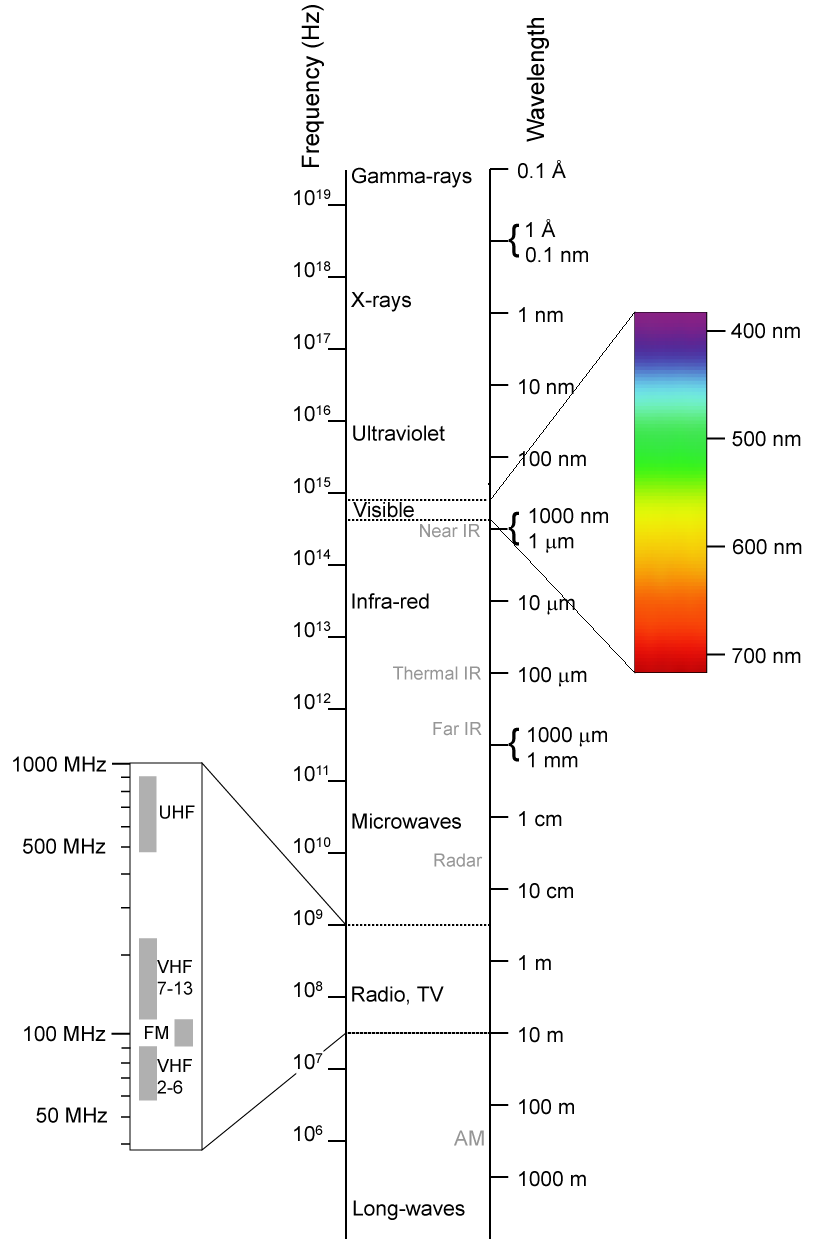
So what makes some radiation scary and some radiation completely safe? Well to answer that we have to know what it can do to a person. Alpha/beta/gamma radiation can do some really nasty stuff that can kill fairly quickly as well as cause cancer - I don't know much about what it is doing when it kills quickly - probably just messing up a bunch of molecules by knocking out electrons. The main fear of radiation is that it causes cancer. It can also heat the inside of the body.
Well what about cancer? Radiation causes cancer by knocking electrons out of molecules in DNA. Once an electron is knocked out it can change the chemical properties and change what the DNA encodes. Then a bunch of biology can happen and end up causing cancer. In order to knock out an electron the radiation particle hitting the electron must have enough energy to knock it out. The key here is that the individual particle must have enough energy. No matter how many times someone lightly pokes you, you'll never break a bone. So if the particles are low energy/low frequency it doesn't matter what the power is. If the particles do have enough energy then the power, and exposure time, do matter because the more particles hitting you the more likely one will hit an electron and cause all the steps required to cause cancer. This is the difference between ionizing and non-ionizing radiation and is the key concept in knowing how dangerous radiation is.
So what radiation is ionizing? Ultraviolet light and higher frequencies, so around 10^16 Hz and above. Cellphones, portable phones, wifi, baby monitors, and bluetooth all use frequencies around 10^8 to 10^10 Hz, one millionth the frequency of ionizing radiation. Most other electronic communication standards use lower frequencies cause generating higher frequencies is really hard. Note that visible light is between any radiation generated by electronics and the frequency of ionizing energy.
Ok, so all these electronics devices don't use ionizing radiation, but microwaves don't use ionizing radiation (2.4*10^9 Hz) and everyone knows that if they stick their head in a microwave bad stuff happens. True, this gets us to the third issue with radiation which is that it can heat parts of your body. Microwaves are the prime example of this since they are designed specifically to heat water, 2.4 GHz is the resonate frequency of water. The human body works really hard to keep its innards within a very specific range of temperatures and outside of that stuff starts to breakdown and cause problems. WiFi uses the same frequency as microwaves and cell phones are sorta close. So it seems reasonable that they could cause heating which would then cause issues. Except they don't put out nearly enough power. Try reheating leftovers by putting your cell phone next to them. A common response is even if the power is small, people spend a lot of time with cell phones next to their heads. True, but again the human body works really hard to keep its insides at the right temperature, so it's not going to have any problem adjusting to some tiny bit of power. Consider that the human body can handle it being 100 degrees outside or 0 degrees outside and still stay 98.6 degrees. Compared to that getting rid of the tiny bit of heat from cell phone radiation is nothing - heck getting rid of the heat from the hot phone touching your head is probably the bigger issue. Microwaves generate about 700 watts of radiation, cell phones max out around 2 watts.
Yeah you say all that, but what about those big studies that show that cellphones cause bad stuff? For that I refer you to my post about shoulder tapping.
A few bonus items:
-People who live near cell phone towers are actually exposed to less cell phone radiation. Most of the exposure is from their phone, which doesn't need to transmit as much power if it is close to a tower.
-If you notice that your ear feels kinda warm and weird after a long phone call on a cell phone, it isn't cause of the radiation, it's cause you were holding a hot, hard object against your ear for a long time. Normal phones have a more comfortable shape and don't get as hot.
If you're still worried about cell phone radiation:
-When you're talking the phone has to transmit a bunch of data so it is almost constantly sending out radiation. When you aren't talking it's just checking in with the tower every once in a while so the amount of radiation exposure is far lower.
-Radiation falls off with distance squared so moving the phone just a little further from your head significantly cuts down on the radiation, plus your ear will appreciate not being pressed against a hot object.
-Bluetooth only needs to cover from your ear to your phone, vs a phone that has to talk to a tower. So bluetooth head sets do transmit significantly less radiation.
-WiFi is actually the one that is the right frequency to heat water. But its range (and transmit power) is much less than a cell phone and people generally don't hold their computer or access point to their head. Sleeping near an access point isn't a big deal because there typically isn't a lot of traffic on your wireless network while you're asleep.
-It might seem that something like streaming a movie would cause more radiation from your phone/laptop because more data is moving over the wireless connection. But when downloading data the only transmitting the device needs to do is send acknowledgements that it's getting the data. That's more transmitting than when the device is doing nothing, but far less than if you're sending a movie to someone.
-Frequency, power and duration are all key to understanding the impacts of radiation so watch carefully what terms are being used when reading about the topic.
Monday, November 29, 2010
Shoulder Tapping
Let's say that for some reason Justin Bieber picks up the habit of tapping people on the shoulder. Then, of course, in a few days every kid in America is tapping everyone they see on the shoulder. The next logical step is some parents get concerned about the health effects of shoulder tapping and make sure that scientists studying shoulder tapping get funded.
Let's say that 200 studies are started. Each study picks a different health effect that seems like it could be connected (impact on bone structure, passing of germs, social anxiety...) and checks if it is correlated with shoulder tapping. These are real scientists who know what they are doing so they properly account for external factors and other correlations and thanks to all the funding are able to get such a large sample size that each study has a confidence level of 99%.
Then a journalist or study of studies scientist comes along and asks every scientist what they found. Turns out that with 99% confidence shoulder tapping causes peripheral vision loss.
There's no theory why shoulder tapping causes peripheral vision loss, but if there's a study showing a chance it is true then best to try to kill the new trend right?
Well, actually, even if there is no correlation between shoulder tapping and any of the studied health effects, the odds that 1 or more studies out of 200 would show a correlation with 99% confidence is 87%. (1-0.99^200). It is actually rather likely that there would be a false positive (even with only 69 studies there's a 50% chance of false positive, and with only 10 studies there's a 10% chance of false positive, much smaller, but still 10x worse than the quoted 99% confidence level).
While the individual studies were done with proper statistics the news story/study of studies was actually done with very poor statistics. Now if a scientist read the news article and then repeated the study of peripheral vision loss and again found a correlation with 99% confidence that would be worth reporting. Of course there would still be some question as to causation, but at least it would be true that there is very likely a correlation.
Thursday, September 16, 2010
Time Travel
There's a particular view of time travel that seems to be preferred by tv and movies. This view is that someone can travel back in time and change something which alters the future. Let's say the character lives till 2010 then travels back to 1980 and changes stuff then travels back to 2010. In the show his time line is continuous from 1980 to 2010 then jumps to 1980 then jumps to 2010. The "first" time he is in 2010 in the past there is only one of him in 1980, the time traveling him hasn't visited that time. The "second" time he's in 2010 in the new history of the world there were two of him in 1980, one the normal and one the time traveler.
Ok, before we go further we have to allow physics to be broken in order to time travel, and even bigger we have to allow causality to be broken. It is difficult to proceed with a logical argument once we're allowing causality to be broken, but logic minus causality is one more thing we'll have to allow for this post to proceed.
It's always seemed to me that if someone time travels from 2010 to 1980, then in 1980 there are two of him and all of the resulting consequences, no matter if it is the "first" time he gets to 2010 or the "second" time, since there aren't two 1980s. (Sometimes shows touch on the idea of switching to a different universe when the time traveling occurs - that would solve the problem, but then the person is both time and universe traveling, not just time traveling*). So that's not a new idea. But what finally occurred to me is why the two different 1980s view of time travel is so natural for TV - you are following the character who time travels and time is progressing based on his view of time so it is possible to see each moment in time more than once as soon as he starts time traveling. Even in a story with many characters, the story will take the view point of only the time traveler for that part of the story. (Heros may be an exception to that rule, but Heroes' time travel rules were really wacky, remember the crazy mesh of strings they called a timeline?)
If a TV show had to draw a time line (based on the reference of a third party - or a non-time traveling character) they would be hard pressed to make it work with this view of time travel. It would be equally difficult to make this work if they also showed events from the perspective of a non-time traveling character. Especially since the time traveler's friend's memory contains one set of events during the "first" 2010 and a different set of events during the "second" 2010.
So I blame the linearity of story telling and the tendency to perceive the story through the view point of a single character for this persistent view of time travel.
Although since we've dropped causality maybe I blame this persistent view of time travel for the linearity of story telling.
(*The universe hopping version of time travel is also somewhat less satisfying since if the character goes back in time to save someone they're not actually saving the person in the original universe, but rather just choosing to live in a universe in which the person survives - that seems to make the story much more shallow. Although I guess if they're not sure how time travel works they could still be well intentioned...)
Thursday, November 19, 2009
The Office and Counterpoint
I think that what The Office has been doing recently is kind of interesting. The show started off with the typical office humor point of view where there's a normal person or two, the boss is incompetent and each coworker has their own bit of insanity. Pretty much the Dilbert formula. I'm not saying there wasn't anything original about The Office (well, ok there was nothing original about the American version), but the perspective was pretty standard. Over the past couple of seasons as Jim has taken on more responsibilities we've seen hints about the transition to come. And now that Jim is a co-manager they've really flipped the situation around. We learn that while Michael is a weirdo and somewhat incompetent, some of the insanity is on purpose and Jim who is expected to know better is actually needing direction from Michael.
Nothing that extraordinary, but if office fans are the Dilbert crowd who go through their day convinced they know better than their boss then the show is in some way now making fun of their fans (or at least correcting them). Seems like a bit of a strange move. Luckily Michael still comes off insane so it is not a complete reversal of views.
This sentence is acting as a transition between topics.
When news and talk shows have Jenny McCarthy on to talk about vaccines I scream "WTF IS GOING ON? WHO'S BEEN HANDING OUT THE STUPID PILLS?". Oh, that's not where I was going with that. Let's try again. When news and talk shows have Jenny McCarthy on to talk about vaccines it might seem appropriate to have another guest who is a vaccine specialist at the CDC or some university explain why vaccines are actually good and talk about the extensive studies that show they don't cause autism.
However, that's not the counterpoint that should follow her appearance. The guest after Jenny McCarthy should be a vaccine specialist at the CDC or some university and should be wearing a sport coat with chalk dust on it over a t-shirt with Maxwell's equations, too loose pants and pure white tennis shoes, also acceptable is a free t-shirt from a career fair plus jeans that were purchased in the early 80s and birkenstocks with white socks, bonus points for taped glasses and extra bonus points for soldered glasses. The scientist should be there to provide a counterpoint to Jenny McCarthy's choice of outfit.
If McCarthy cries foul because she went to the "university of google", the scientist can explain that he went to the university library and read all the books on fashion he could find, most of which happen to be from previous centuries, but hey he read a bunch of stuff so he's just as qualified to discuss fashion as she is to discuss vaccines.
The weird thing is I don't even watch the shows that have McCarthy on, but it generates so much buzz that I hear about it on NPR and news websites. Hm, I just admitted that I'm complaining about interviews I've never even seen. Well I guess I should go ahead and dedicate this post to everyone attending the "university of google" where poorly informed rants like this post count as reading assignments. Remember that anytime a claim from this blog is cited it can be proceed by, "My source, who has a graduate degree from MIT, says...".
Saturday, November 07, 2009
Repeated Dilemmas
On TV there's a reasonably common scenario in which a decision has to be made about trading off risk to an individual vs a group (in fact if you leave on the Syfy channel you'll probably see this multiple times a day). Often there will be two characters who disagree, the one who takes up the "greater good" argument is typically a scientist or other logic driven character and the one who pushes "leave no man behind" or "this is the morally correct way to go" or "how could we live with ourselves" is typically a member of the military or some other hero type character. The scientist argument can sometimes be a mask for "do whatever is least risky for me" which is typically the jerk scientist, but I'll ignore this side of the argument for this post.
I imagine that just about everyone sides with the character who supports saving the individual and so do I (I always side with Helo and almost never side with Baltar).
First I'd like to defend the scientist a little. While I overall disagree, I will say that often "leave no man behind" will pose significant risk to the entire group, and if TV shows didn't care about keeping main characters or audiences then we'd probably see a more balanced set of outcomes which may call the hero choice into question. I think that more movies like The Watchmen would do a lot of good for all other stories since the audience would believe something bad could actually happen (of course that thought is part of the justification for Wash's death so maybe I'll take that back).
However, I would claim that simplistic logic leads to the "greater good" argument and that the scientist character should be far too smart for it. The major downfall of the greater good argument is that on these shows it is almost never a one time event that is being dealt with. But rather something that happens about once a week (ok in the course of the show it may be less often, but is still a repeating occurrence). So they are not in a single game, but a repeated game. (If you're getting bored, just think prisoner's dilemma vs repeated prisoner's dilemma and you've basically got my point).
Yes, in a truly isolated incident maybe it does make sense to loosen your morals for a moment and let one guy die to save the group. However, if this decision is going to be faced repeatedly there are several consequences. For one thing the person out doing something dangerous is probably the person who would do other dangerous things in the future. If an important marine/viper pilot/away team member dies every time there is a threat to the group they're going to have a shortage of these important people. In addition after this happens once or twice that could do some serious damage to moral and reduce the risks team members are willing to take on. Both of these concerns are especially significant if they are a group on say one or more space ships and have no connection with other humans or there are no other humans. Also in situations involving the military it is always going to be a repeated dilemma since at some point the military will face another dangerous situation and its policies and reputation from past decisions will matter.
I think that this logic is somewhat built into human emotions and societal norms/morality. This is why the hero type will know the right answer from a gut feel or moral standpoint. However, writers seem to think that the scientist is applying logic to only the single situation. Seems like they think the scientist showed up for the psychology or economics lecture where the prisoners dilemma was covered, but skipped the next week when the repeated version was discussed.
I think I just took down Spock using logic! Which makes me wonder if Spock and Kurk had the opposite positions would the situation also be reversed in all the scifi shows since then.
Monday, June 01, 2009
Maker Faire
On Sunday I headed to the Maker Faire with Saeed. Thanks to Andy for the free tickets!
Probably the coolest thing there for anyone who played Mouse Trap as a kid was the life size, fully functional version (unfortunately these are iphone pictures so they don't do a good job capturing everything):


Also very cool was seeing the mentos and diet coke guys do their 100 bottle show which was fairly similar to the YouTube video (I know it's so 2002, but how often do you get to see it in person?):

What I think makes this giant hydraulic arm super cool is that someone puts their hand in a glove like thing and the big hand mimics what their hand is doing:

There was some more serious and focused stuff like people who will turn a Prius into a plug in hybrid. And there were some people selling tools and services to DIY types. And some smaller projects, many of which had a bit more focus. And then of course there's stuff like a spinning ball of fire:

And this thing (extra creepy if you saw Terminator the day before), can't see it in the picture, but the video is the people looking at it and is all ascii characters:

And of course some people doing their Steampunk thing.
Overall very cool. I'll definitely try to go again in the future.
Friday, May 22, 2009
Wolframalpha
If you haven't seen wolframalpha yet, it's worth checking out. Some people are trying to play it up as a competitor with google. If that's how you view it you'll be very disappointed. If you take a look at their sample searches there's some cool stuff there. But what they don't seem to play up is that you now basically have free access to mathmatica (one line at a time).
So try stuff like
10*x^3+0.5*x^2+x+100=0
or simplify (x^2 + 4*x + 3)
or d(e^(x^x))/dx
or 4 * (boltzmann's constant) * (300 K) * (100 ohms). Yes, google calculator will do the last one, but it doesn't change the units to (nV^2)/Hz like wolframalpha does.
So try stuff like
10*x^3+0.5*x^2+x+100=0
or simplify (x^2 + 4*x + 3)
or d(e^(x^x))/dx
or 4 * (boltzmann's constant) * (300 K) * (100 ohms). Yes, google calculator will do the last one, but it doesn't change the units to (nV^2)/Hz like wolframalpha does.
Wednesday, February 18, 2009
Wine Pump and Project #2
After letting the wine bottle sit for 120 hours we took a look. While we didn't have any way to measure the exact volume of the balloon, it looked like the size before we pumped out the air. When I pressed on the air release it make some noise, but it was fairly brief. So the pump does does a decent job of removing air, but not of keeping new air from seeping in.
Even after switching the cap the battery charger still wasn't fully charging the batteries. So I put an ammeter in series with the batteries and found they were only getting 0.4 mA - about 1/1000 of what it should be. So I looked back over things for a bit and found that I had put the pnp in backwards. Doh! Well now it is in the right direction and the charge current is 430 mA. Much better - hopefully that will do the trick.
Even after switching the cap the battery charger still wasn't fully charging the batteries. So I put an ammeter in series with the batteries and found they were only getting 0.4 mA - about 1/1000 of what it should be. So I looked back over things for a bit and found that I had put the pnp in backwards. Doh! Well now it is in the right direction and the charge current is 430 mA. Much better - hopefully that will do the trick.
Friday, February 13, 2009
Balloon in Wine Bottle
There was a disagreement at work about how well hand vacuum pumps for wine bottles work. So I brought my wine bottle pump and a bag of balloons and someone else brought in an empty sparkling cider bottle. We put a balloon in the bottle and held the end of the balloon. A coworker used a coffee stirrer to push on the neck of the balloon to keep it from filling the neck of the wine bottle while he blew into the balloon. It took him a few tries, but he got enough air into the balloon so that it was stretching a little and then tied the end. Then he pushed the balloon so it fell to the bottom of the bottle. Then I used the wine bottle pump just as I would when trying to preserve wine. The balloon grew as I pumped out the air in the bottle. The growth was very noticeable, but very far from filling the entire bottle. We made a very rough guess that the volume of the balloon increased by 4x. I think that means I pumped out 75% of the air in the bottle. That's more than I expected and I think enough to justify using the pump.
The next part of the challenge is to see if the stopper's seal holds over several days. So the bottle with the balloon in it is sitting under the desk in an empty cube (no one wanted a bottle sitting in their cube). On Tuesday we'll check how big the balloon looks (very tough to tell much from this since no way to compare the size - I tried to take a picture, but the bottle was dark enough it didn't really work, see below). The other test will be pushing on the valve and listening for the air going into the bottle.
Well it is about as far from scientific as you can get, but I'd say the bottle pump is worthwhile.
Look for the pink blur at the bottom of the bottle:

Saturday, November 15, 2008
Loop Gain
A lot of people are 5 to 10 pounds above their goal weight.
A feedback system measures the difference between the output of the system and the goal and amplifies the difference (well, in the most simple of feedback systems). After the system stabilizes the output is approximately equal to the input, but there is an error equal to the output divided by the gain of the system.
It is reasonable to figure that the further people get from their goal the harder they try. So they are always doomed to be a bit above their goal. Perhaps lots of people have a loop gain that pushes them just enough to maintain their weight when they are 5 to 10 pounds over.
I guess all this leads to the Dr. Cox view of weight loss - once you are happy with your body you lose.
I've heard that expression about a person with a hammer seeing everything as a nail, but it doesn't apply to me because I have feedback analysis, not a hammer.
Friday, November 14, 2008
So close
From this NYT article:
Chief Justice Roberts took issue with both restrictions. The Navy had agreed to shut down its sonar if marine mammals were sighted within 200 yards. The appeals court’s requirement that it increase the zone to 2,200 yards, Chief Justice Roberts said, would “expand the surface area of the shutdown zone by a factor of over 100,” given “the exponential relationship between radius length and surface area.”
So close to sounding smart and yet so far. Well, at least he got the numbers right.
(x^2 is a polynomial, 2^x is an exponential function, the area of a circle would get really big really fast if it was an exponential function of the radius)
Am I being really petty? Yes.
Thursday, October 23, 2008
Life on other planets will be a let down
I realized today that if we ever discover life on other planets, initially it will be a serious let down. There's not going to be a moment of serious excitement, but rather a very long series of small steps.
The most likely way to find life on another planet is to find something like bacteria. Which to some scientists will be really exciting, but overall - whoo hoo - bacteria. Plus it will be really hard to prove that it didn't just get put there by coming in contact with the person or robot that found it. Heck there was that thing with the asteroid or whatever a long time ago and it was sorta big news for a while and now I can't even remember the story.
But let's say we actually discover intelligent life, which I think is what most people mean when they talk about discovering life. I think we've explored our solar system enough to know we're not going to find anything too interesting here. So one possibility is we'll get some questionable photo from a satellite which will then have to be followed up by another satellite that will take a really long time to get there. Once it gets there it could get exciting, but we're probably talking years if not decades. And that's probably just to get more pictures.
If the life we find is technologically advanced the other reasonably likely possibility is we would find a communication from them, may or may not be directed to us, long before we found them. Would probably be found by something like SETI. So we'd find an odd radiation pattern. Then over a long time it would be confirmed - have to make sure it was computed properly and check that it is persistent and not caused by human activity. Even if it said something interesting it would take a long time to figure out what it says. Or it could just be the spectrum from something like a power plant rather than a communication. Anyway, that's all years right there, then figuring out a way to send a signal and them catching on and so on would be a really long time. So maybe at some point regular communication could be set up which would be exciting, although travel to them would probably be decades if not centuries away.
I have no idea why this occurred to me today. At first it just sounded like a silly idea, but now I'm actually kind of bummed out.
Thursday, September 11, 2008
Rivalries are Fractals!
There's a bit of a rivalry between the "East" and "West". It has probably been built up to be more than it would be by politicians trying to blame "them" for "our" problems.
Within the West there is a rivalry between the US and Europe. It is not a strong one, but it exists and comes and goes based on world events. Right now it is probably more distinct if you don't count the UK as part of Europe (and don't forget Poland!).
Within the US there are rivalries between different regions. There is at least somewhat of a rivalry between each pair of the west coast, the midwest, the south, and the northeast. Politics has really highlighted some of these rivalries. At this level people can start to get offended if you confuse which region they are from.
Within the midwest there are rivalries between different states. This level tends not to be as strong, but it does exist, especially if you include the impact of sports.
Within Kansas there is a rivalry between cities and rural areas (ok, maybe cities should be in quotes unless we include a slice of Missouri).
There is a rivalry between the two "cities" in Kansas - Kansas City and Wichita.
Within Kansas City there is a rivalry between the "Johnson County" types and other areas (I should really know Kansas City better than I do).
Within Johnson County there are rivalries between the different school systems. Within Blue Valley there are rivalries between the different high schools. Within a high school there are rivalries between the grades. Within a grade there are rivalries between the different groups...
I wanted to go down a path that I had a "right" to go down. Although I think there are some far more interesting paths (think going from UK vs the rest of Europe then England vs Scotland and Ireland then Ireland vs Scotland). No matter how much you zoom in you have the same basic picture. That's a fractal!
The odd part of rivalries is that as you zoom in they tend to get more intense (ooops, so much for being fractals). Again the example of going from Europe down to Ireland vs Scotland comes to mind. Or here's another path:
From my personal observations some reform Jews have little problem learning about and participating in Eastern religions, have a bit more hesitancy going to a church, and show significant resistance to taking part in orthodox Judaism.
I think a piece is that the closer the alternative is, the more likely it is to be true, so people feel more need to distinguish themselves from it. Although I don't think that explains all of it. I bet if I bothered to open my intro to psych book or do 5 minutes of googling someone would probably have a real explanation, but instead you get a page of thoughts that have been forced together to create what can't even be called a hypothesis (since it makes no testable predictions, hm, maybe Sarah Palin will defend teaching it in schools like she does for creationism).
Since the penalty for confusing someone in one group for being in another increases as the proximity and similarity of the groups increases it really discourages trying to group people. Since if you go too broad there's no point and if you go too narrow any inaccuracy will cause great offense. Which is a way more hippie, we're all just people, conclusion than I intended. And I don't think it is valid since there is some value in recognizing cultural differences and you can't do that if you're not willing to do at least a little grouping. Aren't you glad you went through all that to get a conclusion that is clearly wrong?
On a total tangent: Picking which path I had a "right" to go down was a bit odd. I've been told I have to spend around 10 years in California before I can claim to be a Californian (and go through an earth quake, although I'm not sure how I'm going to distinguish that from the sound of loose floorboards shaking due to the people upstairs running around or that few minutes of rhythmic shaking that comes from my next door neighbors around the same time each night). And having left SoCal it is like I'm starting over with the Bay Area. There's no way I can claim Bostonian since that was just for college. Paris was way too short for that claim (plus the lack of speaking french). I don't even remember living in Ohio. So Kansas City (or as demonstrated in this post I feel the need to specify Overland Park) would seem to be the strongest claim. Although having lived there for about 14 years on and off and then not having lived there for 8 years I'd say I'm quickly losing that claim. I'm a nothing-an. Throw in a lack of real religious identification and not being particularly skinny or fat and while being a bit on the short side I can't really identify as short or tall. I would make the worst stand-up comedian ever! There's no group I can get away with making fun of and then say "it's ok I'm one of them"! I guess I always have my nerdyness - I feel the need to go read slashdot and be with my people.
PS Since this post is free to travel through any of the tubes I feel the need to add that I'm not really having an identify crisis. And yes I do realize I'd be in the short category. And if the dentist who converted in that episode of Seinfeld gets Jew joke rights, I've totally earned them.
Wednesday, August 20, 2008
x^n+y^n=z^n
First for those that don't know the basics on Fermat's last theorem:
Back in 1637 Fermat wrote down a conjecture (or theory depending on if you believe what he wrote next or not) in the margin of a book and then wrote: "I have discovered a truly marvelous proof of this, which, however, the margin is not large enough to contain". For the next several hundred years many mathematicians worked on proving the conjecture. In 1993 Professor Andrew Wiles presented the proof he came up with after working in near isolation for 7 years. Soon after people realized the proof had an error. Then he spent a year trying to figure out how to fix it and eventually did.
Fermat's last theorem says that the equation x^n+y^n=z^n does not have whole number solutions for n > 2. An example of a solution for n=2 is x=3,y=4,z=5 since 3^2+4^2=5^2.
The book Fermat's Last Theorem starts in 2000 BC and tells the stories of the key mathematicians that led up to the conjecture and then those that led to the proof. It is actually an interesting way of taking brief (4000 years is a long time to cover in 150 pages) snapshots of the development of math across time. For the very early stuff, when the math is more understandable, the book goes into it a bit, but it does a good job of shifting its focus to the people as the math gets harder. It also does a good job of dispelling the idea that it was one guy in a 7 year stint that created the proof when really it was the build up of hundreds of years of effort. Also he wasn't unabomber isolated - he had a family and near the end even worked with two other professors, but he did spend a lot of those 7 years in his attic and kept his work secret the whole time. One of the interesting aspects of the proof is that it is actually done by proving a correspondence between two ideas in completely different areas of math. So rather than being a pure number theory proof it actually involves ideas about curves and other modern areas of math.
One thing the book reminded me of is that my math education cuts out somewhere in the early 1800s (except a small amount of very specific applied stuff). I'm not saying I know a lot up to then, but that is the point where I'm lucky if I recognize the name of a field, much less an actual concept. Which I guess is a combination of math being really old and thinking that I know something about math even though I've never taken an actual pure math class.
Anyway, the book was surprisingly interesting, although considering the topic is 4000 years of math building up to a single proof it didn't have to do much to exceed expectations.
Sunday, August 17, 2008
In The Beginning... Was The Command Line
In my continuing quest to read everything Neal Stephenson has ever written I read In The Beginning... Was The Command Line. It is his take on operating systems when it was written in 1999. Given when it was written there are few people I would recommend it to (if you read this blog and you were in AEPi then it might be worth checking out). Although, if you are in that group then you know most everything the book says (although Neal does come up with some colorful analogies, which is actually a bit odd since a major portion of the book is talking about the issues with using a GUI as an analogy for what is really happening in a computer).
In the end he recommends BeOS which has since died. Although most of the reasons for recommending BeOS (fresh start and combination of GUI with access to command line interface) could be applied to Mac OS X (as he mentions here in response to question 8). I was a bit disappointed to find out that Neal is an emacs guy, although I probably would have been too if not for a certain roommate steering me in the right direction. For the last few pages he goes off into craziness as required of any Stephenson book (actually it is impressive that he touches on the ideas Seth Lloyd talks about in Programming the Universe which came out 7 years later).
In the end he recommends BeOS which has since died. Although most of the reasons for recommending BeOS (fresh start and combination of GUI with access to command line interface) could be applied to Mac OS X (as he mentions here in response to question 8). I was a bit disappointed to find out that Neal is an emacs guy, although I probably would have been too if not for a certain roommate steering me in the right direction. For the last few pages he goes off into craziness as required of any Stephenson book (actually it is impressive that he touches on the ideas Seth Lloyd talks about in Programming the Universe which came out 7 years later).
Tuesday, August 12, 2008
Ghostwalk
Finished my signed copy of Ghostwalk (thanks for the book Mom and Dad) recently. It did start slow, but once it got going it was cool.
So the real history is that Newton in addition to being super science guy was also into alchemy and around the time he was going for a fellowship there were a few mysterious deaths that helped open up the position to him. Apparently he had not yet made a real impression by time he was going for the fellowship.
The author took the facts and came up with a story to explain it. Then to frame the story (I really want to use the term frame since it is one of two terms I remember from the literature class I took, although I don't think it is quite right since what I'm calling the framing is really the more significant portion of the story) she tells a story about present day Cambridge. The present day story revolves around a book with the Newton story the author is putting forward, and there are murders that are linked to the ones in the past.
I think this may be the first novel I've read that is set in the 2000s. Reading a story that involves people text messaging each other is a bit odd, not good or bad, just odd. The modern day story is told from the perspective of a woman who is dating a married man so I did have a little trouble relating to the main character. But the story was still interesting and the inner story about Newton was good. I also really liked that at the end she had a section specifying what is really known and what isn't so you aren't left half knowing a bunch of stuff.
Sunday, July 27, 2008
(50-3)^2
I was at the AT&T store yesterday thinking I was going to get an iPhone (turns out I could order one and get it in a few weeks - no thanks - if the gratification isn't instant I don't want any part of it). There were a few kids in the store playing with the iPhones on display. I think they were about 10, but I think all kids are about 10 (if you ever listen to my childhood stories you'll realize that I think half my life occurred during that one year). One of them decided that the most interesting thing to do with the iPhone was to type math problems into its calculator and then see if the other kids could get the right answer. While I wanted to play with the iPhone (although I'm a bit ashamed that I would have been using it to watch TV) I liked that the kid was doing math and doing the problems in my head provided entertainment while I waited to be disappointed by the lack of iPhones.
At one point the kid asked his mom - what is 47 times 47 and she responded 10,000 clearly just brushing off the question. To her credit - she was at a cell phone store with her kids - I think if you make it through that without going on a murderous rampage you've done good (I think that counts even without the kids). But I was so tempted to tell the kid how to do the problem. (instead of doing 47*47 do (50-3)^2 which is then just three easy problems: 50*50, 2*50*3, and 3*3 then subtract and add) but I figured that would not have been appreciated. But don't you think that in the interest of teaching a kid math most normal social rules should be suspended?
I convinced myself that I wrote this as just an amusing story since I haven't posted in a bit and as a question about societal rules. But I'm afraid it is really just a way to release a pent up need to tell someone how to easily square 47, which really isn't that satisfying considering that many of you know as much or more math than I do.
Saturday, June 28, 2008
n^n
On the one hand it is cool to have an n^n birthday. But at the same time it is too bad that the first time you are old enough to realize your age is n^n is also the last time (well unless you're a super advanced 1 or 4 year old - 1 is actually the coolest since it is n^n for two values of n). Medical science is going to have to make some serious advancements and really fast if I'm going to make it to my next one. 11011 is a sort of cool age, although I guess I've got a few more years before I'm completely "on" (11111) and only a couple more till I get a prime. Why is it that all jokes involving binary are bad jokes? And why do I publish them on the internet anyway?
On a completely different topic: Having lived in 3 cities in CA over 3 years I'm fairly used to scientology centers and christian science reading rooms. However, protesters in front of a scientology center wearing V for Vendetta masks, holding protest signs and dancing to music is a new one for me.
On a completely different topic: Having lived in 3 cities in CA over 3 years I'm fairly used to scientology centers and christian science reading rooms. However, protesters in front of a scientology center wearing V for Vendetta masks, holding protest signs and dancing to music is a new one for me.
Thursday, May 29, 2008
Back in Signoff
When basic arithmetic falls through the cracks, David reports on it in a segment we call back in Signoff.
About a week ago there was a news story that McCain wants to reduce emissions by 60% by some date and Clinton/Obama want to reduce it by 80% by that same date. First off - super glad to hear that McCain is at least partially signed on to fighting climate change (not that he'll win, but still nice to hear).
What is the difference between an 80% reduction and a 60% reduction? Both sound significant. 80% sounds like a bit more - in politics terms it is a 20 point spread. Maybe it is just me, but read off in those terms - gut reaction - not a giant difference.
Let's say we are currently producing 10 units of CO2 per year. After a 60% reduction that's 4 units per year. After an 80% reduction that's 2 units per year. So McCain's proposal is 4 units, Clinton/Obama's is 2 units. That's a factor of 2! That's big. In fact if the Clinton/Obama proposal were 84% instead of 80% then it would be 1.6 units - which would be the same as saying do McCain's reduction, then do it again!
PS - if someone makes the mistake of actually paying attention to what I say - they might point out that in the past I said factors of 2 are no big deal. First off - I'll admit that previous post was pushing expectations a bit too far. But my main point there was hybrid cars make up a small portion of all cars and cars only make up a portion of total pollution. So if they want to make a significant impact they need a serious reduction (the front runner should be far better - wind is way more than 2X better than coal...). BUT the plans discussed above are the whole thing (for America). So a factor of 2, means a factor of 2.
Separate topic - last week or two I was more social than usual with people in the area and less social than usual with others. This weekend I'll start to make up for the second part (hopefully won't cause a corresponding drop in the first).
Subscribe to:
Posts (Atom)